
The next HCM contest is over who gets to act
Look beyond the assistant. Follow the permissions, connections and commercial dependencies that determine whether work actually gets done.
Inaugural baseline · Selected developments from 2026 and current documentation. This is not a claim that every item launched this fortnight. Desk research, not hands-on product testing.
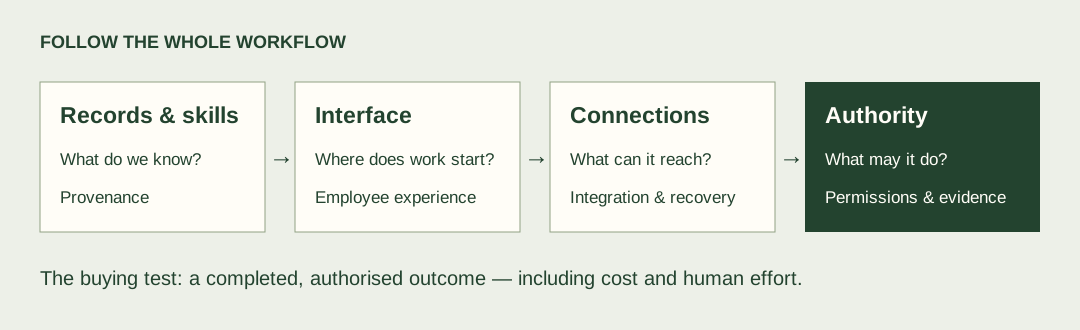
The signal: vendors are competing for the route through work
An AI interface can make a system easier to use. It can also become the place where employees start their day, route requests and select downstream tools. Our hypothesis is that control of this route could become commercially important alongside ownership of the employee record. The evidence below supports investigating that possibility; it does not establish a winner.
Four approaches, four questions to ask
These suppliers occupy different layers. This is a comparison of documented approaches, not a ranking or a claim of equivalent scope. Price, regional availability and performance require buyer-specific verification.
| Supplier / layer | Documented signal | AyEye scrutiny | Ask for this evidence |
|---|---|---|---|
| SAP SuccessFactors Suite and skills | The April 1H release describes skills governance and connected recruiting/onboarding. | Consistent skills labels do not prove that someone can perform a task. | Trace one skill from its source to an actual decision; show corrections and partner synchronisation. |
| Oracle Fusion HCM Embedded workflow | The AI feature catalogue lists journey-triggered workflow agents in 26B. | A release entry does not establish that your tenant, permissions or process are ready. | Show the trigger, approval boundary, exception handling and recovery in your configuration. |
| Workday / Sana Interface and execution | The March announcement describes cross-system actions and availability through Flex Credits. | An included allocation is not evidence of unlimited or predictable cost. | Price a completed workflow, including failures, retries and human review. |
| Merge Connection and access | Its documentation separates employee authentication from tool access and describes additive permissions. | More connectors do not establish end-to-end process reliability. | Demonstrate effective access for a person in several groups, including removal and revocation. |
Sources: SAP release, 13 April · Oracle release catalogue · Workday announcement, 17 March · Merge technical documentation. Vendor-authored evidence; no independent comparative benchmark was found in these materials.
“No tools” may not remove access
Merge documents that access accumulates across defaults, groups, individual settings and approved requests. A group with no tools does not remove a grant from another source. Each employee must also authenticate connectors separately. The page was checked for this issue; its launch date was not established.
Our scrutiny: the setting name alone is an unsafe guide to effective access. Ask an administrator to demonstrate a joiner, a person changing roles and a leaver. This is a configuration question, not evidence of a security incident.
Wider implication: as tools become reachable from more AI interfaces, permission inheritance becomes a buying criterion. A connector count is a poor substitute for that test. Read the documented behaviour →
Workday bought another part of the route
Workday’s fiscal-2026 fourth-quarter investor presentation reports that its Pipedream acquisition closed. That is a completed-deal statement, not merely the earlier intention to acquire. Investor presentation →
Our inference: bringing integration capability inside a suite may help it reach work outside its own applications. It could also shift bargaining power between the suite, standalone integration providers and implementation partners.
What remains unproven: ownership does not establish seamless integration, support quality or customer savings. Ask what remains separately contracted, which connectors support the required actions, and how workflows can be exported if the relationship ends.
Three less visible developments worth following
- Skills governance: SAP’s emphasis on consistency across its suite and partners could matter more to workforce planning than another chat interface. Test provenance and refresh cycles before treating a skills profile as capability evidence. Source
- Triggers rather than chat: Oracle’s catalogue links workflow-agent behaviour to journey events. That suggests attention should move to when actions occur, not only how an employee asks for them. Confirm feature release and tenant enablement; later catalogue entries must not be mistaken for live availability. Source
- Consumption economics: Workday’s Flex Credit route makes usage assumptions relevant to the commercial comparison. Request a written worked bill for a representative month; the announcement alone does not supply a comparable total cost. Source
A use case that makes the comparison concrete
Illustrative, not a customer result: a manager needs to onboard a transferred employee. Compare the complete process: correct role data, access changes, learning assignments, approvals and evidence of completion. Run the same difficult cases through each proposed approach. Count manual handoffs, unresolved errors, review time and total cost. A convincing demonstration should include a failed step and recovery, not just the happy path.
What this could mean for the roadmap
Now · Investigate
Map one cross-system workflow. Establish who owns each decision, which contracts apply and where staff repair gaps. Ask existing suppliers to prove the complete outcome before adding another layer.
Next · Preserve choice
If cross-system execution becomes dependable, integration and permission design become strategic capabilities. Retain process documentation and exportable data; do not assume a common protocol makes switching effortless.
Longer term · Watch the balance
A suite could become the main interface to a wider ecosystem; alternatively, a separate orchestration layer could leave suites as records. Watch customer adoption, portable workflows and actual support arrangements before backing either outcome.
What would weaken our thesis? If most valuable work remains inside individual applications, or cross-system reliability and cost remain poor, the interface contest may matter less than stable core processes. Niche specialists can still win where they demonstrate a capability a suite cannot deliver economically.
How to read Tech Tack
We distinguish an announcement, documented availability, vendor-selected customer evidence and independently demonstrated outcomes. None is interchangeable. This first issue samples three global suite vendors and a specialist integration provider; it is not a global market census. Country, language, hosting, licensing and implementation differences remain open questions. Future editions will rotate regions and ecosystem layers, record small signals and revisit conclusions when evidence changes.
Our scrutiny is of claims and consequences. Inclusion is not endorsement, and absent evidence is not proof that a capability is absent.
Go deeper: Workforce: who should authorise agents? · Practical Impact: a bounded test for managers