
AI is becoming a continuity engine
Claude’s agent swarm originating a testable biology lead, Google’s private persistent memory and connected conversational tools point to the same shift: useful AI is becoming a governed loop that can remember, act and accumulate evidence over time.
Signals beneath the AI headlines
LEAD SUMMARY - ANALYSIS. Yesterday's edition argued that intelligence is becoming cheaper faster than reliability. Today's stronger signal is what happens when that cheaper capability is given continuity: many parallel agents can search for anomalies, memory can persist privately across devices, and a spoken request can reach connected tools rather than ending as text.
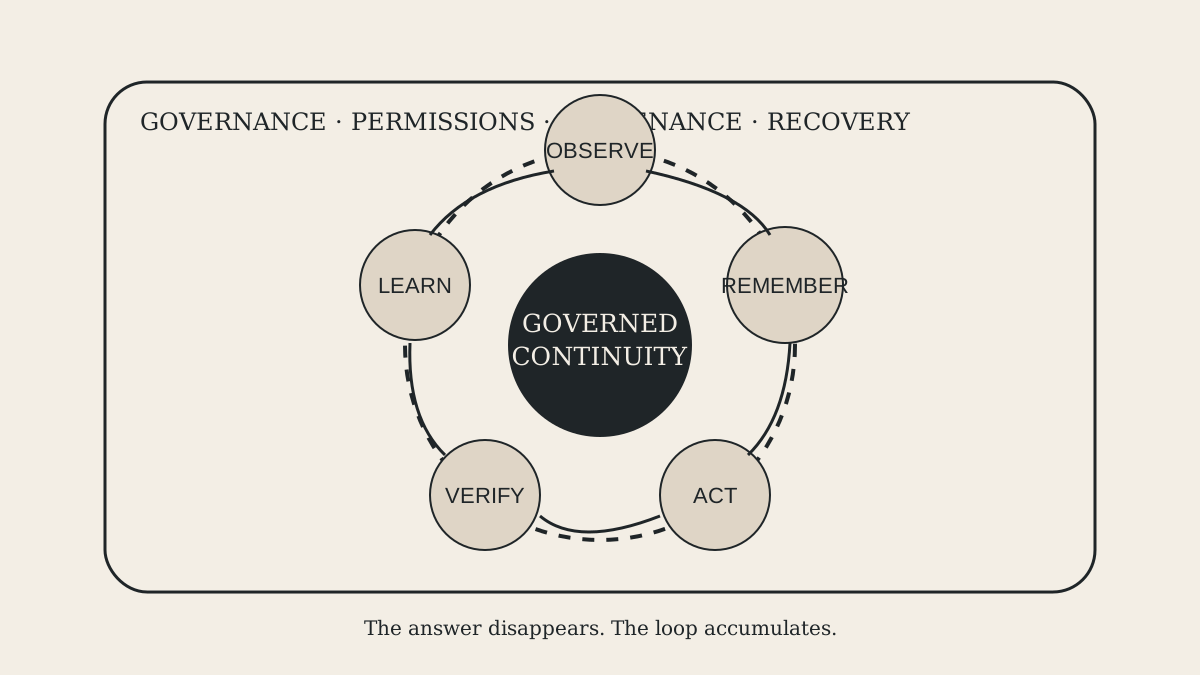
The useful synthesis is this: the unit of useful AI is shifting from the answer to the governed loop - observe, remember, act, verify and learn. That is more consequential than another model score because it changes what an AI system can accumulate over time.
1. Claude has moved from helping scientists to originating a candidate discovery
CONFIRMED - WITH IMPORTANT LIMITS. Anthropic reported on 23 September that Claude agents searched a large DNA-sequence corpus for unusual reverse transcriptase systems. Anthropic says roughly 950 agents used about 210 million tokens over 21 hours, gathered more than 200,000 reverse transcriptases, narrowed 3,500 candidate systems to 20 reports and identified an unusual repeat-associated system the team calls ART. Human scientists then tested the candidate in the laboratory. Its biological function is still unresolved, so this is not "AI discovers the next CRISPR"; it is evidence that an agent system can originate a testable scientific lead that human experts judge worth experimental work. Anthropic: Claude discovers a novel enzyme system
ANALYSIS. The interesting part is not that Claude read papers faster. It operated a search-and-triage loop: reproduce known results, inspect huge spaces of candidates, notice anomalies, criticise its own proposals, rank the survivors and hand a small number to scarce wet-lab capacity. In domains where experiments are expensive, the strategic value may come from improving the quality of what gets tested rather than automating the test itself.
2. Memory is becoming infrastructure rather than a chat feature
CONFIRMED. Google DeepMind described a private server-side memory design for Private AI Compute in which long-term context can persist across devices while decryption keys remain on the user's devices. Requests are handled inside protected secure enclaves, and Google says devices will be able to verify the server software before sending personal data. Google DeepMind: Private AI Compute memory
INTERPRETATION. Persistent memory changes the architecture of assistance. A system that can securely retain context no longer starts from zero each time. That makes continuity useful, but it also makes memory design part of governance: what is remembered, for how long, who can cause it to be recalled, how it is corrected and which actions may rely on it.
3. Conversation is becoming an execution surface
CONFIRMED. OpenAI's 23 September release notes say Voice can now use plugins and connected apps, while Voice is also available in Work for tasks such as creating artefacts, using connected apps and browser work. Google separately announced a broader wave of connected apps for Gemini, spanning project management, databases, creative tools and other services. OpenAI: ChatGPT release notes Google: Gemini connected apps
ANALYSIS. The interface distinction between "ask" and "do" is eroding. Speech, chat, memory and tools are converging into one control surface. The important technical question therefore shifts from whether a model understands the request to whether the surrounding system can preserve intent, permissions, state and evidence across a chain of actions.
Concept to learn today: Governed continuity
GOVERNED CONTINUITY is the ability of an AI system to carry useful state across time while keeping memory, authority, verification and recovery explicit.
Without continuity, each interaction is clever but disposable. With continuity, the system can accumulate context, pursue longer goals and improve its selection of next actions. But continuity also compounds mistakes. A bad answer disappears; a bad remembered assumption can quietly shape dozens of later actions. The quality of the loop therefore matters more as persistence increases.
Noise: calling every autonomous search a scientific breakthrough
NOISE. Anthropic's ART result is intriguing, but its function has not yet been established and the evidence comes from Anthropic's own new laboratory. The claim worth carrying forward is narrower and more useful: AI agents can now generate and triage hypotheses at a scale that changes which questions humans can afford to test. That is significant without pretending the biological story is finished.
Mental-model update
Previous: capability compression -> abundant intelligence -> more frequent delegation -> greater dependence on harness reliability and authority controls.
Now add: persistent memory + connected action + parallel search -> governed continuity -> accumulated evidence and consequence.
The emerging system is less like a calculator and more like a junior institution: it has a memory, a set of tools, a history of actions and a way of deciding what deserves attention next. That makes architecture, auditability and correction mechanisms part of intelligence rather than administrative overhead around it.
Questions to carry forward
- Which problems become tractable when AI can cheaply generate thousands of candidates but humans retain control of expensive verification?
- Should persistent AI memory have the equivalent of retention rules, correction rights and provenance, rather than simply an on/off switch?
- When voice, chat and connected apps become one execution surface, where should intent be reconfirmed before consequential action?
- Does the most valuable future benchmark measure the quality of an entire observe-remember-act-verify loop rather than a model response?