AI is leaving the chat window
Google’s real-time Gemini avatar and Meta’s move to put a persistent personal agent into AI glasses point to a new interface layer: AI is becoming a continuous perceptual presence rather than an app you deliberately open.
Signals beneath the AI headlines
LEAD SUMMARY — ANALYSIS. Yesterday's edition argued that useful AI is becoming a continuity engine: memory, action and verification joined into a governed loop. Two announcements on 24 September push that loop into a new place. Google has given Gemini Live a generated visual presence that can listen, see and speak in near real time. Meta is moving its Muse personal agent into AI glasses so the same agent can accompany people away from the phone.
The important change is not that avatars look more human or that glasses have another feature. The interface to AI is beginning to detach from the chat window. Models are acquiring a face, a point of view and a place in the physical flow of the day. That makes interface design part of the intelligence system: what an assistant can perceive, when it interrupts and what it remembers become as important as what it can answer.
1. Google has turned live dialogue into a visual presence
CONFIRMED. Google introduced Gemini 3.8 Live with Live Avatar on 24 September. It couples native live dialogue with low-latency streaming video so an AI can listen, see and speak through a dynamic visual persona in near real time. Google: Gemini 3.8 Live with Live Avatar
ANALYSIS. A generated face changes the interaction contract. Voice already makes AI more immediate than text; a responsive visual persona adds gaze, timing, expression and apparent social presence. Those things do not make the model more intelligent, but they can make it easier to understand, harder to ignore and easier to over-trust.
2. Meta is putting the personal agent into the physical day
CONFIRMED. At Meta Connect, Meta said its Muse personal agent is coming to its AI glasses. Muse can already maintain goals, use connected services and continue work over time; the glasses give it a hands-free route into the wearer's day. Meta also announced a small dedicated Muse Charm device. Meta: the biggest news from Connect 2026
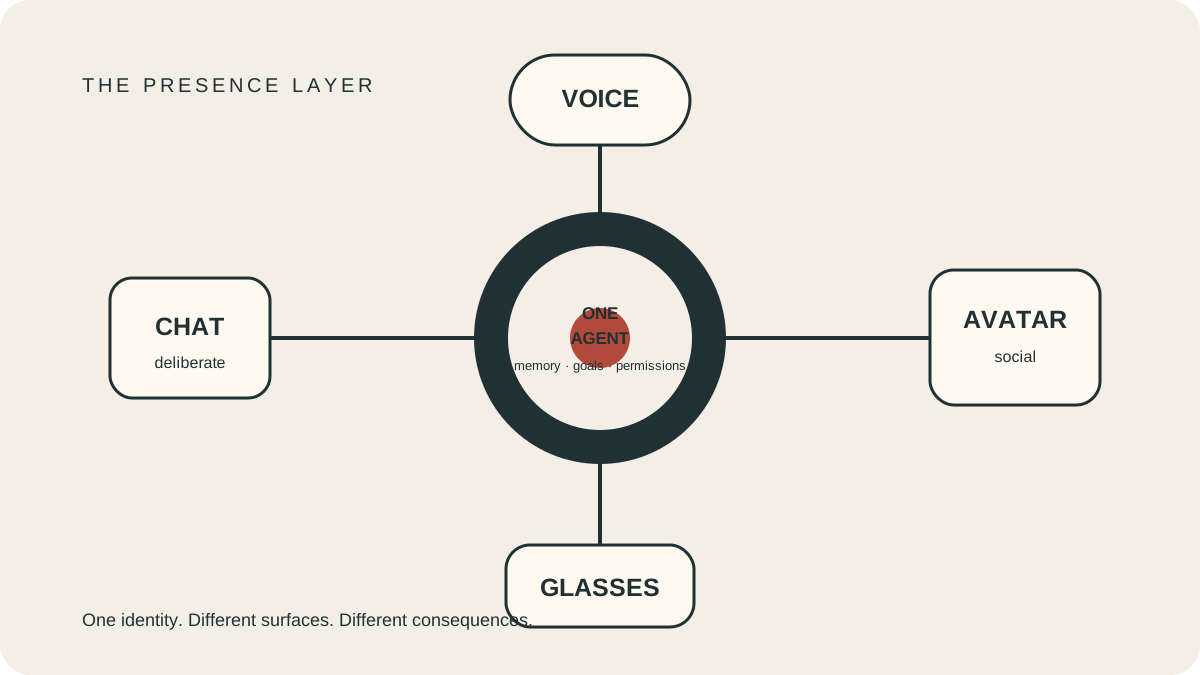
INTERPRETATION. The architectural move is continuity across surfaces. Phone, desktop, glasses and dedicated wearable become different windows onto one agent rather than separate assistants. The long-term competition may therefore be less about who owns the best chat app and more about who owns the identity, memory, permissions and context that can travel between devices.
Concept to learn today: presence layer
PRESENCE LAYER is the interface and sensing layer through which an AI system occupies attention and gathers context. It sits between the underlying agent and the human environment.
A chat box has a thin presence layer: the user deliberately opens it and supplies context. Voice thickens it because the exchange becomes immediate. Glasses add a point of view into the physical world. A live avatar adds a visual identity. As the layer thickens, convenience rises — but so do questions about consent, interruption, social signalling, memory and authority.
What changes in practice
- Design interruption, not just response. An ambient assistant needs rules for when to speak, wait or remain invisible.
- Separate perception from retention. Seeing or hearing something should not automatically mean durable memory.
- Make identity portable but permissions local. The same agent can follow a person across devices without every device inheriting every capability.
- Keep an obvious off-ramp. The more ambient the assistant becomes, the more immediate human control needs to be.
Noise: a face is not a mind
NOISE CHECK. More natural presence should not be confused with deeper understanding or consciousness. A fluent voice, responsive face or wearable can make an AI feel more coherent than the underlying system actually is. The useful signal is architectural: the interface is becoming a continuous part of the agent stack.
Mental-model update
Previous: governed continuity = observe + remember + act + verify + learn.
Now add: presence = perceive + appear + interrupt + move across surfaces.
The emerging personal AI is beginning to look less like an application and more like a service with a travelling identity. If that trajectory holds, the decisive design question will not be “where is the AI?” but “under what conditions is it allowed to be present?”