
The next agent skill is restraint
Microsoft is turning persistent agents with identity and memory into a mainstream enterprise product, while a newly human-validated memory benchmark shows that recall alone is not enough. Useful continuity depends on knowing when to intervene — and when to stay quiet.
Signals beneath the AI headlines
LEAD SUMMARY — ANALYSIS. The last two editions followed AI from continuity into presence: systems that remember across time, then appear across more surfaces. The next problem is less glamorous and more important. Once an agent remembers, when should that memory actually change what it does?
Two fresh signals make the question concrete. Microsoft has introduced Autopilot as a persistent enterprise agent with its own identity, memory, computer and workspace. At the same time, the newly human-validated TWIST benchmark reports a stubborn trade-off in long-conversation memory systems: configurations that catch more contradictions can also flag too many harmless cases, while systems that rarely over-intervene can miss genuine conflicts. The scarce capability is beginning to move from recall towards intervention judgement.
1. Microsoft is making persistence a normal enterprise product
CONFIRMED. On 25 September, Microsoft announced a redesigned Copilot centred on Home, Code and Autopilot. Microsoft describes Autopilot, previously called Scout, as a cloud-hosted digital teammate that can be given a name, role and goal, monitor channels and threads, carry out recurring work and resume a project days later without waiting for another prompt. Microsoft says it has its own identity, memory, computer and workspace inside the organisation's tenant. Microsoft: new Copilot with Home, Code and Autopilot
ANALYSIS. This is not merely another assistant feature. A system that persists over days and across channels is accumulating context faster than a user can consciously restate it. Memory becomes operational infrastructure: it influences which thread the agent follows, what it treats as current and which earlier facts it brings into a new decision.
INFERENCE. That means the quality question changes. A short-lived assistant can be judged mainly on whether it answers correctly. A persistent agent also has to decide which remembered fact deserves attention now. Too little intervention leaves contradictions and stale assumptions untouched. Too much intervention turns memory into a nagging supervisor that sees tension everywhere.
2. TWIST measures whether memory knows when to step in
CONFIRMED — RESEARCH. TWIST is a proposed benchmark for intervention quality in conversational memory. Its latest draft, dated 25 September, includes a human-validated version of its draft-alignment track. The benchmark asks not only whether a system can retrieve earlier information, but whether it correctly intervenes when an outgoing draft conflicts with the record — while also refraining on matched cases that merely look contradictory. TWIST: intervention quality in conversational memory
CONFIRMED — RESULTS. On the human-validated Track B key, the paper reports that no tested configuration simultaneously achieved high contradiction recall, high specificity on difficult benign cases and high evidence attribution. Flat retrieval-augmented baselines detected between 76% and 97% of true contradictions, but falsely flagged 16% to 43% of closely matched safe drafts depending on the backend. A coherence-oriented deployed system almost never over-flagged, but caught only 42% of true contradictions.
IMPORTANT LIMIT. TWIST is not a complete verdict on agent memory. The present paper human-validates one track; other tracks are specified for later instantiation. The evaluated systems and datasets are also narrower than the messy reality of enterprise work. The result is useful because it exposes a missing axis of quality, not because it crowns a winner.
3. Recall and judgement are becoming separate capabilities
ANALYSIS. Most memory benchmarks have historically rewarded retrieval: can the system bring back the relevant fact? Persistent agents need a second capability: can they use that fact appropriately?
A perfectly recalled statement can still be harmful if it is stale, superseded or irrelevant to the current decision. Conversely, a system that aggressively flags every apparent inconsistency can make work worse by interrupting valid changes of mind, context shifts and harmless differences. The technical target is therefore not maximum memory. It is calibrated intervention.
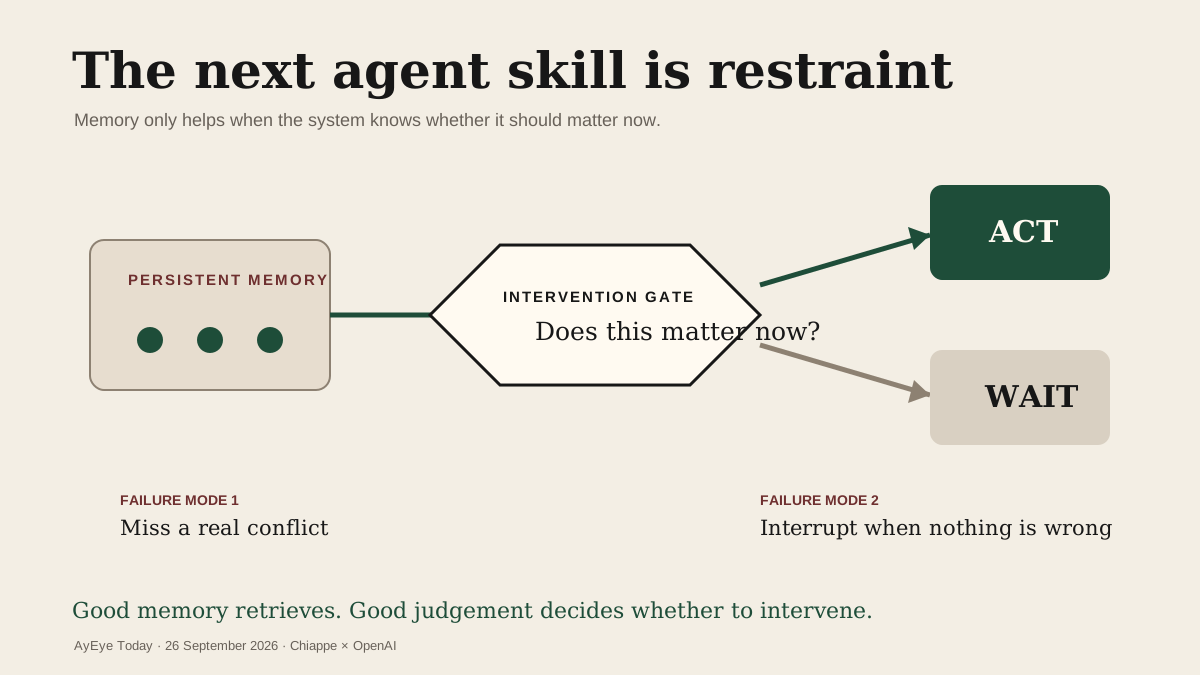
INFERENCE. This suggests a new architecture for persistent agents. Memory should not flow directly into action. Between the two sits an intervention gate that asks whether the recalled context is current, relevant, sufficiently evidenced and important enough to alter the next step. In other words, persistence needs a judgement layer.
Concept to learn today: Intervention quality
INTERVENTION QUALITY is how well an AI system decides when remembered context should alter, block, challenge or leave alone a proposed action.
It has two sides. Sensitivity matters because the system should notice genuine conflicts, outdated assumptions and consequential changes. Restraint matters because unnecessary intervention creates friction and false confidence in the memory system. A useful metric therefore has to price both misses and false alarms.
This is particularly important for agents that remain active over long periods. The longer the memory, the more opportunities there are for facts to change, goals to evolve and earlier statements to become context rather than instruction.
Noise: more memory is not automatically more intelligence
NOISE CHECK. It is tempting to treat ever-longer memory as an uncomplicated capability gain. It is not. A larger store can increase retrieval coverage while also increasing the number of irrelevant, stale or superficially conflicting facts available to influence behaviour. The useful question is not “how much can the agent remember?” but “how well can it decide what deserves to matter now?”
Mental-model update
Previous: governed continuity → persistent memory and action; presence layer → the same agent becomes available across more surfaces.
Now add: persistent memory → intervention gate → act, challenge or wait.
The emerging agent stack is therefore acquiring a new middle layer between memory and execution. Retrieval supplies possible context. Intervention judgement decides whether that context should change the task. Action happens only after that decision. As agents become longer-lived, the quality of that middle step may matter as much as the size of the memory itself.
Questions to carry forward
- Should persistent enterprise agents expose separate measures for recall quality and intervention quality rather than one generic memory score?
- Who decides how cautious an agent should be when old context conflicts with a new instruction: the vendor, the organisation, the user or the task itself?
- How should a long-running agent distinguish a genuine contradiction from an intentional change of mind?
- Will the most useful agent benchmarks increasingly measure restraint and timing, not just completion and accuracy?