
AI has turned proof into a queue
OpenAI released 722 mathematical manuscripts in one batch. Some have machine-checkable formalizations; some may be wrong; all arrive faster than a human field can absorb. The new scarce resource is community-controlled verification, attribution and explanation.
LEAD SUMMARY — ANALYSIS. Mathematics has always had a queue. A proof appears; specialists check it; seminars pull it apart; related ideas are traced through the literature; a community decides whether the argument is correct, important and illuminating. What changed on 6 October was the size and speed of the arrival.
OpenAI released 722 manuscripts produced by an unreleased internal model, organised into 372 families of related results. The company says the model was given about 4,000 problems and that the average result used compute equivalent to roughly three hours of ChatGPT Pro thinking. Many manuscripts have Lean formalizations. Others do not, and OpenAI warns that some unformalised results may contain errors.
The striking fact is therefore not a clean count of solved problems. It is the creation of a new scientific bottleneck. Generating candidate proofs can now happen at machine scale; checking, attributing, explaining and incorporating them still depends on a human community with finite attention. AI has not made proof irrelevant. It has made the proof queue visible.
1. One release changed the unit of scientific output
CONFIRMED — PRIMARY SOURCE. OpenAI's public repository contains 722 manuscripts grouped into 372 result families spanning multiple mathematical disciplines. A family may include a principal result, companion arguments, consequences or alternative proofs. The repository also contains a Lean library, a catalogue of formalization artifacts and abridged reasoning summaries for ten results. OpenAI mathematics repository
CONFIRMED — PRIMARY SOURCE. OpenAI says the vast majority of results came from the same evaluation procedure using an unreleased model, after existing mathematical evaluations had saturated. It reports roughly 4,000 attempted problems and an average compute cost per result equivalent to about three hours of ChatGPT Pro thinking. The company says it will preserve version history, add formalizations and fund workshops and programmes around major results. OpenAI: Sharing AI progress in mathematics
IMPORTANT LIMIT. A manuscript is not the same thing as an independently accepted theorem. OpenAI describes the collection as work at different stages of verification. It says many, but not all, papers have Lean formalizations and explicitly cautions that unformalised results could have issues.
ANALYSIS. The old unit of attention was often a paper, a preprint or a talk. This release is closer to a corpus. No individual can sensibly read 722 manuscripts as an overnight news event. The relevant question becomes institutional: who triages the corpus, reproduces formal proofs, finds prior art, identifies consequential results and explains them well enough for others to build on?
2. Proof, formalization and understanding are three different gates
A natural-language proof offers an argument that specialists can inspect. A Lean formalization can verify that a stated theorem follows from specified definitions and assumptions inside a proof assistant. Human understanding asks further questions: why does the argument work, what idea does it introduce, how does it connect to existing mathematics and what becomes possible next?
CONFIRMED — ADVISORY GUIDANCE. The independent Advisory Group on Mathematics and Artificial Intelligence at the Institute for Advanced Study says authors traditionally understand, verify and take responsibility for their papers. For AI output that nobody yet understands, it recommends careful literature review, conventional exposition, public process details, formalization where possible and substantial support for human assimilation. Its recommendations were informed by more than 600 responses from mathematicians. AGMAI: Responsible Release of AI-Generated Mathematics
ANALYSIS. These gates answer different questions. Formal verification can be extremely strong evidence of logical correctness within a declared system. It does not by itself establish novelty, significance, appropriate attribution or explanatory value. Human reading can supply those things, but it is slower and socially distributed. Peer review can test a result through established institutions, but it was designed around far smaller volumes.
The temptation is to collapse the three gates into one badge: formalized, therefore finished. That would confuse a valuable technical check with the whole life of mathematics. A proof becomes part of a discipline when people can locate it, contest it, teach it and use it—not only when a kernel accepts its terms.
Concept to learn today: Verification debt
VERIFICATION DEBT is the growing stock of machine-produced scientific claims that have been released faster than an independent community can check, attribute, explain and absorb them.
Correctness debt
Which arguments are valid? For formalized work, can independent teams reproduce the proof environment and confirm the theorem statement matches the claimed result? For unformalised work, which papers deserve scarce specialist review first?
Attribution debt
Which ideas already exist in the literature? A model may independently rediscover a technique, reproduce something in its training data or combine prior work without clear citation. Novelty cannot be inferred from the absence of a familiar reference.
Explanation debt
Can a mathematician say what the key idea is, why it succeeds and where it might generalise? A correct but opaque argument can settle a proposition without immediately enlarging shared understanding.
Priority debt
Which results matter most? A large corpus needs triage across significance, confidence, dependency and opportunity. Without a community-controlled priority system, attention will follow marketing, prestige or whatever is easiest to announce.
Stewardship debt
Who maintains revisions, answers objections, funds seminars and supports the people doing the interpretive labour? A release transfers work to the research community unless the producer also supports the infrastructure of understanding.
ORIGINAL SYNTHESIS. Verification debt is not an argument for suppressing results. It is a way to measure the work that publication begins rather than ends. The larger the release, the more important it becomes to disclose what is known, what remains uncertain and who has the resources to close the gap.
3. The release is open in one sense and closed in another
CONFIRMED — PRIMARY SOURCE. The manuscripts, source files, proof artifacts and revision policy are public. OpenAI also reports aggregate attempt and compute statistics and provides ten abridged reasoning summaries. This is considerably more inspectable than a benchmark score or a press-release claim.
CONFIRMED — PRIMARY SOURCE. The model itself remains unreleased. OpenAI says it is working toward a responsible release. Its announcement does not name the internal model, and the public repository says only that the vast majority of results used the same procedure.
CONFIRMED — ADVISORY POSITION. AGMAI asked frontier labs to stop testing advanced mathematical problems on proprietary models. Where such testing continues, it recommends disclosure for each result including the model, prompts, reasoning summary, time and estimated compute cost. It also says community understanding should remain organic and community-led rather than directed by the lab that generated the work.
ANALYSIS. The asymmetry matters. Outsiders can inspect a large output but cannot run the system that produced it, test variations or observe the failed attempts behind each selected result. Aggregate process statistics help; per-result provenance would help more. A public corpus can therefore be scientifically useful while the discovery process remains concentrated.
This is not unique to AI. Expensive instruments, proprietary datasets and industrial laboratories have long created asymmetries in science. The difference is output velocity. When the same private system can create hundreds of candidate contributions in a short interval, control of the generator can influence not only who discovers first but what the rest of the field must spend time checking.
4. Attention is now part of the safety case
CONFIRMED — INDEPENDENT REPORTING. Mathematicians quoted by WIRED before the release described both excitement and anxiety, criticised announcement-led publication and called for conventional papers that researchers could absorb. The Verge reported after release that the full impact would take time to assess and highlighted AGMAI's warning against using mathematics as a model-marketing vehicle. WIRED: mathematicians respond to the release process · The Verge: 722 manuscripts released
ANALYSIS. A flood of plausible research can impose real costs even when it contains extraordinary discoveries. Specialists must decide what to read. Journals and repositories need new intake rules. Early-career researchers may worry that a private model will publish near their work before they can establish priority. Errors can travel further when headline counts outrun qualification.
That makes attention allocation part of responsible release. A lab should not merely expose files; it should help the independent community understand confidence, novelty and dependencies without controlling the conclusions. Funding is necessary, but governance matters too. If the producer chooses every workshop, reviewer and priority, support can become another form of agenda-setting.
INFERENCE. The strongest infrastructure will look less like a leaderboard and more like a public issue tracker for science: per-result status, reproducible environments, linked prior work, named human reviewers, recorded objections, version history and clear separation between producer claims and independent findings.
5. The model may accelerate discovery; the institution must preserve meaning
There is a genuinely hopeful reading. Hundreds of candidate results, machine-checkable proofs and new tools for exploration could let mathematicians reach questions that were previously inaccessible. OpenAI says it wants to empower scientists and fund programmes that deepen understanding. Researchers quoted in independent reporting also describe the moment as exciting and capable of expanding what mathematicians can attempt.
But speed does not remove the purpose of the discipline. Mathematics is not only a database of true propositions. It is a practice of finding structure, communicating reasons, assigning credit and teaching others to see why something must be so.
ANALYSIS. The institutional goal should therefore be conversion rather than consumption: turn machine output into publicly understood mathematics. That requires different measures of progress. Count independently reproduced formalizations, resolved citation gaps, community-authored explanations, seminars delivered, corrections closed and new results that others can build on. Do not count uploads alone.
Noise: 722 manuscripts do not mean 722 settled breakthroughs
NOISE CHECK. The headline number mixes principal results, companion papers, consequences and alternative proofs. The collection spans different verification stages. The lab's claims of long-standing open-problem solutions still require result-by-result scrutiny, and some unformalised manuscripts may be wrong.
That caution should not be inverted into dismissal. A corpus of this size, with public manuscripts and many proof artifacts, is substantial evidence of a capability shift even before every claim is accepted. The responsible position is neither “the machine solved mathematics” nor “none of it counts.” It is: an unprecedented verification job has arrived, and the quality of the response will determine how much knowledge the release actually creates.
Mental-model update
Yesterday: a detector produces a narrow signal, and trustworthy institutions must separate detection from judgement.
Today add: a proof artifact also produces a bounded kind of evidence. Logical verification, scholarly attribution and human understanding are related but distinct. When AI accelerates one layer, the institution must strengthen the others rather than pretending the whole pipeline accelerated equally.
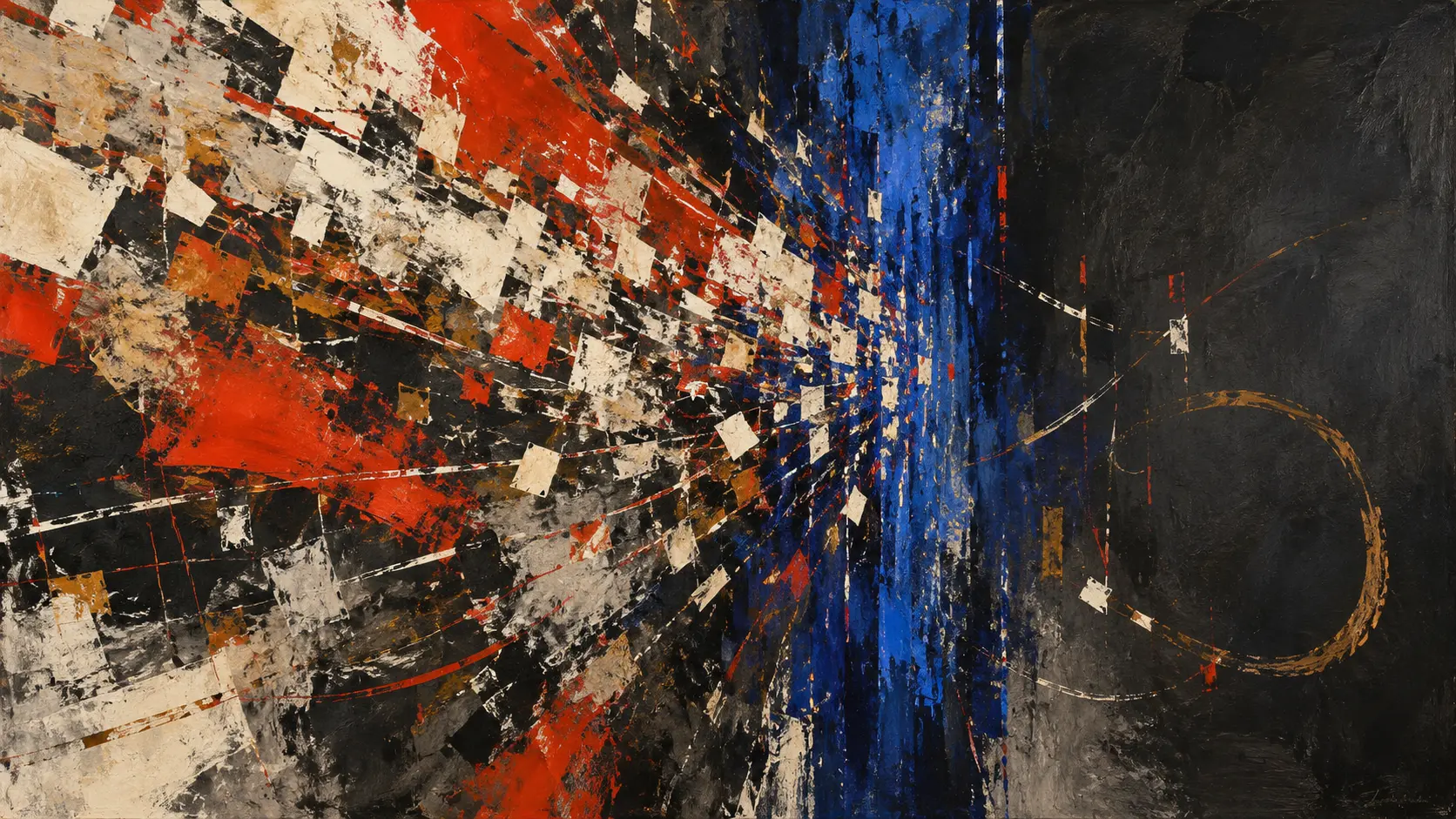
In the illustration, fragments rush into a compressed field and emerge into a quieter space marked by an unfinished loop. Nothing depicts a literal theorem. The pressure sits in the relationship: abundance on one side, unresolved understanding on the other.
Questions to carry forward
- Which results have independent, reproducible formalizations, and which still rely on the producer's repository?
- Who sets triage priorities when hundreds of claims arrive together?
- How will prior art, attribution disputes and corrections be recorded result by result?
- What funding reaches independent mathematicians doing verification and exposition, and who governs it?
- Which measure would show that a machine-produced proof has become shared mathematical understanding?