What if a company could grow from a seed?
A person supplies an ambition. A living network of people and agents assembles the capabilities to pursue it. The company becomes something you cultivate.
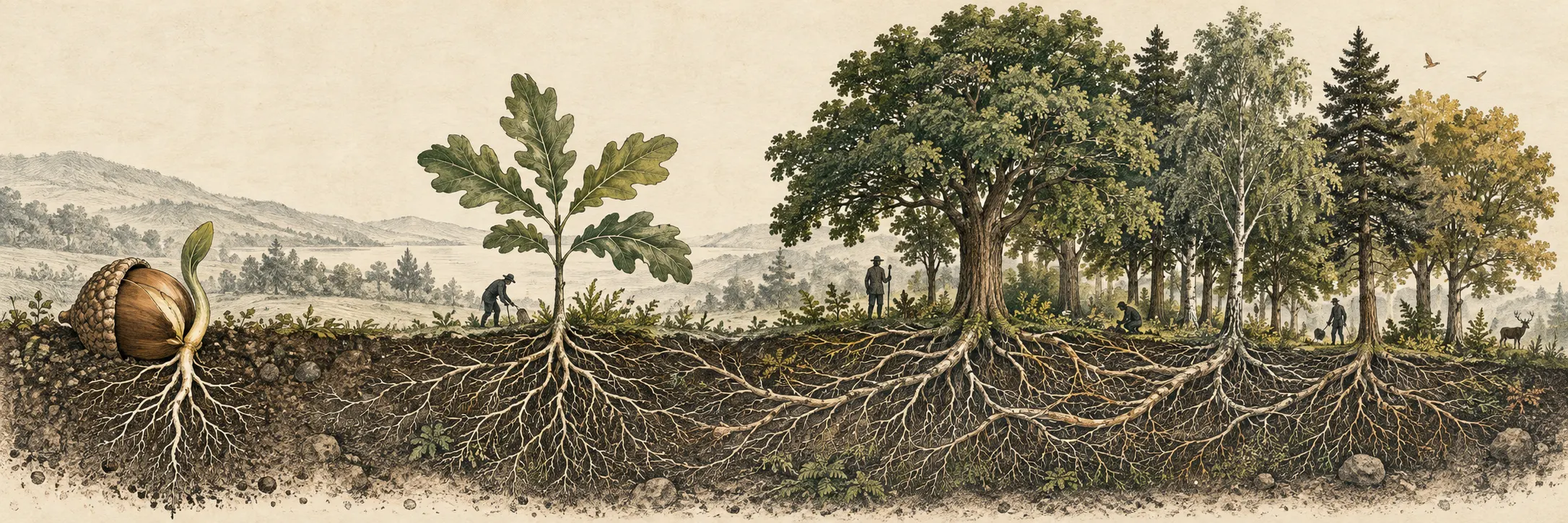
The seed: a useful capability
A small business gives an agent a bounded objective: turn customer enquiries into reviewed proposals. A person sets the terms, approves commitments and judges quality. The benefit to test is quicker service with fewer hand-offs.
The grove: capabilities cooperate
If memory, identity, verification and integration become reliable, specialised agents could coordinate research, pricing, fulfilment and support. People could assemble a temporary team around a customer outcome. The scarce skill becomes choosing the objective and managing exceptions.
The forest: an organisation grows
Imagine a local community proposing an affordable retrofit service. Its agent network discovers demand, designs offers, finds qualified tradespeople and coordinates delivery. Each completed project adds reusable knowledge. A small founding team could develop the reach of a much larger enterprise.
Starting a company could become closer to planting a seed.
Capital and headcount might become less decisive for some services. Judgement, trust, access to customers and the ability to define worthwhile outcomes could become more decisive. Communities and small teams might create institutions that once required a large corporate centre.
How the argument grows
Signal: the archived editions describe persistent agents, external verification and workforce control systems. Context: sustained execution could reduce the coordination cost of work. Connection: combine those capabilities with trusted human services and digital markets. Inference: more work may be assembled around outcomes. Speculation: organisations could grow and recombine continuously, like an ecosystem.
The dates are exploratory horizons, not forecasts. The archive records the reported developments; the seed-to-forest argument is new editorial speculation.
What would have to become true?
- Agents would need to perform sustained work reliably at an affordable total cost.
- People would need clear accountability, consent and control over consequential decisions.
- Knowledge and reputation would need to travel between systems without losing provenance.
- Customers would need to trust the service, and workers would need a fair share of the value.
What could change this view?
Persistent error rates, expensive supervision, restrictive integration and concentration of platform power could keep this model small or shift its benefits towards incumbent firms. The strongest early evidence would be repeatable customer outcomes from small teams, including the cost of human oversight.
What to measure along the way
Time from idea to first customer. Cost per completed outcome. Rework and error rates. Human supervision hours. Customer retention. The share of value reaching the people doing the work.
Read the general AI edition → · Read the workforce edition →