
Oracle Cloud HCM: when breadth becomes both the advantage and the problem
A deep guide to Fusion HCM’s person and assignment model, Redwood, analytics, Dynamic Skills, OCI agents, integration, commercial dependencies and customer reality.
ORACLE · PRODUCT, ARCHITECTURE AND DIRECTION
Oracle Fusion Cloud HCM is easiest to underestimate when viewed only as an HR suite. Its strategic proposition rests on the wider Fusion Applications and Oracle Cloud Infrastructure estate: HCM, finance, supply chain, analytics, integration, database and AI agents can share an enterprise platform. Its difficulty is the mirror image of its strength. Breadth creates power, but also configuration density, overlapping tools and a formidable need for design discipline.
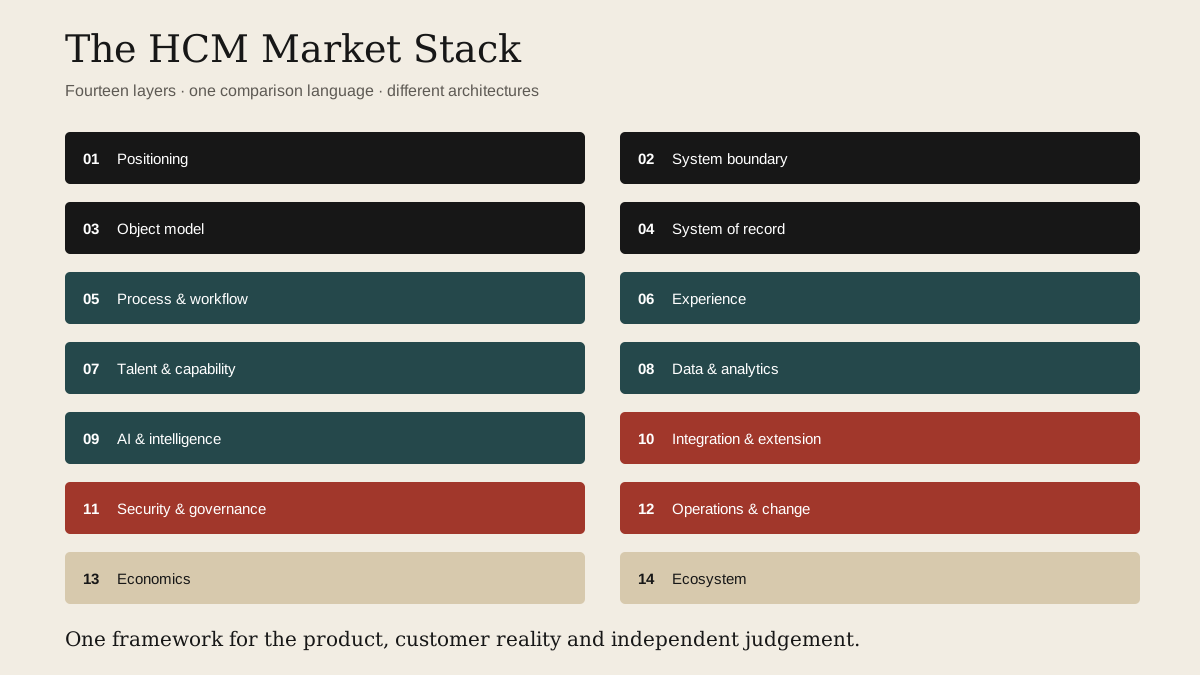
The fourteen-layer market test
| Layer | What must be understood |
|---|---|
| 1 · Positioning | The management problem the vendor says it solves |
| 2 · Boundary | What is native, acquired, connected or external |
| 3 · Object model | How people, jobs, positions, organisations, skills and agents are represented |
| 4 · Record | Authoritative data, effective dating and lifecycle |
| 5 · Process | Rules, workflows, events and exceptions |
| 6 · Experience | Employee, manager, candidate, HR and administrator interaction |
| 7 · Capability | Recruiting, learning, performance, succession, skills and planning |
| 8 · Data | Reporting, analytics, semantics and operational joins |
| 9 · Intelligence | Prediction, generation, recommendation and agents |
| 10 · Extension | APIs, integration, events, custom objects and low-code |
| 11 · Governance | Identity, permission, privacy, audit and agent authority |
| 12 · Operations | Release, testing, migration, support and ownership |
| 13 · Economics | Licence, consumption, implementation and hidden cost |
| 14 · Ecosystem | Partners, marketplaces, dependencies and lock-in |
Workforce lifecycle coverage
This map locates the principal Oracle capabilities and the dependency most likely to shape real-world delivery. It is a coverage guide, not a completeness score.
| Stage | Principal product centre | Important dependency or seam |
|---|---|---|
| Plan and organise | Global HR structures, position management, workforce modelling and planning | Legal employers, business units, reference sets and finance dimensions must align |
| Attract and recruit | Oracle Recruiting and candidate experience | External sourcing, assessment, consent and candidate-to-worker conversion cross boundaries |
| Hire and onboard | Recruiting, Journeys and Global HR | Pending worker, person, work relationship and assignment records have distinct roles |
| Schedule, time and absence | Time and Labor, Absence Management and scheduling capabilities | Legislative rules, payroll relationships, devices and workforce category affect design |
| Pay and reward | Payroll, Workforce Compensation and Benefits | Legislative coverage, element design, integrations and quarterly change create continuing work |
| Develop and mobilise | Learning, Career Development, Opportunity Marketplace and Dynamic Skills | Inferred, declared and evidenced skills should remain distinguishable |
| Perform and progress | Performance, Goals, Succession and Talent Review | Redwood configuration, approvals and security profiles jointly shape transactions |
| Engage and support | Oracle ME, Journeys, Touchpoints and digital assistants or agents | Experience consistency depends on Redwood adoption, content and service ownership |
| Retain and redeploy | Dynamic Skills, Succession, Workforce Modelling and analytics | Signals distributed across OTBI, Fusion Analytics and operational data require semantic control |
| Exit and maintain obligations | Global HR termination, Payroll, Benefits, HCM Extracts and integrations | Multiple assignments, final processing, security and records retention require coordinated closure |
Executive judgement
AYEYE VERDICT · CONFIDENCE: MEDIUM-HIGH
Oracle offers the broadest vertically integrated enterprise technology stack of the three. Value depends on whether the organisation can turn that breadth into a simple operating model rather than a larger Oracle estate.
1–4 · The Fusion HCM model
Oracle distinguishes the person from the work relationship and assignment. One person can have multiple work relationships with legal employers and multiple assignments. Legislative Data Groups, legal entities, business units, departments, jobs, grades, positions, locations and reference-data sets control how data is shared and localised. Date-effective records preserve history and future changes; effective sequence can distinguish multiple changes on the same day.
This is a powerful global model, but the hierarchy matters. A request to “treat everyone the same” can collide with different legal employers, worker types, assignments, payroll relationships, security profiles and statutory rules. As with SuccessFactors, candidate, pending worker and employee are lifecycle states with distinct data and permissions rather than cosmetic labels.
5 · Transactions, approvals and configuration
Fusion transactions combine responsive pages, business rules, approval workflows, security and background processes. Autocomplete Rules, HCM Experience Design Studio and Transaction Design Studio can control defaults, validation, visibility and transaction behaviour; BPM and approval configuration manage routing. Redwood is Oracle’s modern design system and increasingly the required experience layer, with Visual Builder Studio used for supported extension.
The practical risk is overlapping mechanisms. A behaviour may be controlled by page configuration, rule, profile option, security role, reference data or workflow. A strong design authority prevents local teams from solving the same requirement in different layers.
6–7 · Experience, talent and Dynamic Skills
Oracle ME provides the employee experience around journeys, communications, connections, touchpoints and self-service. Recruiting, Learning, Performance, Career Development, Succession, Workforce Compensation and Workforce Planning form the talent portfolio. Redwood is intended to create a more consistent consumer experience, but migration can be a programme in its own right because extensions, training and regression tests must move with it.
Dynamic Skills combines a skills centre, skills advisor and skills nexus to infer and curate skills across people and jobs. Its architectural advantage is access to Fusion HCM transactions and the wider Oracle data estate. Its practical challenge is familiar: inferred skills, declared skills and evidenced competence are different objects and should not be collapsed into one confidence score.
8–9 · Analytics and AI agents
Oracle customers navigate several analytical routes. OTBI provides subject-area reporting over transactional data. BI Publisher supports pixel-perfect and high-volume outputs. HCM Extracts handles complex outbound files. Fusion Analytics and Oracle Analytics Cloud support broader models, while OCI data services can connect HCM with operational and external sources. Tool choice should follow latency, volume, semantic control and audience rather than habit.
Oracle has moved aggressively into Fusion AI agents. By August 2026 it was promoting agentic applications and agents for talent management, alongside AI Agent Studio for configuring and extending agents. The strategic advantage is proximity to both applications and OCI models, search, integration and security. The questions are whether a specific agent is delivered or planned, which Fusion actions it can invoke, how prompts and tools are governed, how customer extensions survive updates and how consumption is priced.
Agent Studio creates a route for customers and partners to build specialised agents, but agent proliferation can recreate the same integration sprawl at a more autonomous level. An agent catalogue, mandate model, evaluation evidence and retirement process are as important as build tooling.
10–12 · Data movement, integration and operations
HCM Data Loader and HCM Spreadsheet Data Loader support bulk inbound data. REST APIs support transactional integration; SOAP services remain relevant in parts of the estate. HCM Extracts is a major outbound mechanism. Oracle Integration Cloud provides process and application integration, while events and business objects can support more responsive patterns. Each mechanism has different validation, effective-dating and error-handling characteristics.
Security combines abstract and job roles, duties, privileges, data roles and security profiles. This can express fine-grained access by population and business context, but role design becomes complex quickly. AI agents must be tested against the same data-security and segregation-of-duties model as people and integrations.
Oracle supplies quarterly updates, with test environments receiving changes before production. The cloud removes customer-controlled version upgrades but not impact assessment. Redwood adoption, opt-in features, deprecated behaviour, integrations, reports and extensions require a permanent release-management capability.
13–14 · Economics and ecosystem
Oracle publishes list pricing for portions of its cloud portfolio more often than SAP or Workday, but enterprise deals remain negotiated. Total economics depend on hosted employee measures, modules, environments, payroll, analytics, OCI services, Integration Cloud, AI consumption, implementation and support. A discounted suite can be expensive if customers must operate several overlapping reporting and extension tools.
Oracle’s partner ecosystem is large and experienced, particularly where customers already use Fusion ERP or OCI. That can make cross-functional transformation coherent. It can also encourage programmes to expand before the operating problem is understood. Architecture and process simplification should precede module accumulation.
CUSTOMER EXPERIENCE AND DELIVERY REALITY
What full-stack practice looks like
Mature customers frequently combine Fusion HCM with Fusion ERP, an identity platform, Oracle Integration Cloud or another middleware, enterprise data platforms, payroll providers, service management and specialist talent products. They value breadth, localisation, configurable journeys and the possibility of common finance–HR reporting. Common frustrations include security complexity, quarterly regression effort, reporting-tool choice, implementation dependence and user inconsistency during Redwood transition.
The quality of an Oracle implementation varies markedly with the clarity of enterprise structures and reference-data design. A technically successful configuration can still produce a bewildering operating model when legal employers, business units, departments and security populations have been designed independently.
INDEPENDENT ASSESSMENT
Structural strengths
- HCM, ERP, analytics, integration and cloud infrastructure can be governed within one broad stack.
- Strong global employment, payroll and legislative modelling.
- Multiple industrial-strength routes for data load, extraction, reporting and integration.
- OCI gives Oracle control over models, data services and agent tooling beneath Fusion applications.
- Redwood offers a route to coherent experience if migration is treated as product change, not reskinning.
Structural limits
- Breadth produces overlapping tools and specialist knowledge requirements.
- “Embedded AI” can still rely on separate OCI services, configuration and consumption.
- Quarterly innovation creates continuing test and adoption cost.
- Dynamic Skills inherits the evidence and governance problem common to the market.
- Customer extensions must remain inside supported Redwood and Fusion patterns.
Questions for Oracle
- Which person, work relationship and assignment record is authoritative for this decision?
- Which behaviour is controlled by Redwood configuration, autocomplete rule, security or workflow?
- Which analytical tool is intended—and why is it preferable to OTBI, BI Publisher or an extract?
- Is the AI agent delivered, configurable, previewed or announced?
- Which Fusion privileges and external tools can the agent invoke?
- What OCI, Integration Cloud or consumption charges sit outside HCM subscription?
- How will quarterly updates and Redwood changes be regression tested?
ONE THING
IF I WERE TO DO ONE THING NOW
Create one authoritative map of enterprise structures
For one country and process, map legal employer, legislative group, business unit, department, position, job, grade, cost centre, work relationship and assignment. Add which structure controls security, payroll, approval, reporting and finance. If different teams cannot explain the map consistently, an AI agent will not remove the ambiguity; it will execute through it.
Sources and status
Oracle Fusion talent agents, August 2026 · HCM Data Loader REST API. Availability, geography and commercial entitlement must be confirmed in the customer’s Oracle documentation and contract.
Version 1.1 update. Added the workforce-lifecycle overlay so functional coverage can be read separately from the fourteen architectural and operating layers.
Maintenance note. This is a dated analytical baseline, not a permanently current product sheet. Material changes are recorded in the series change log. Generally available capability, preview, announced direction, partner dependency and AyEye inference are kept separate.