Platform dossier · Workday
Can one coherent core become the interface for all work?
Object model, business processes, security, analytics, Skills Cloud, Sana and Flex Credits.
Read or listen →
Thinking about how organisations perform in an AI-enabled world
A layer-by-layer guide to what enterprise HCM platforms are, how they work, what customers experience and where each vendor’s strategy is taking the market.
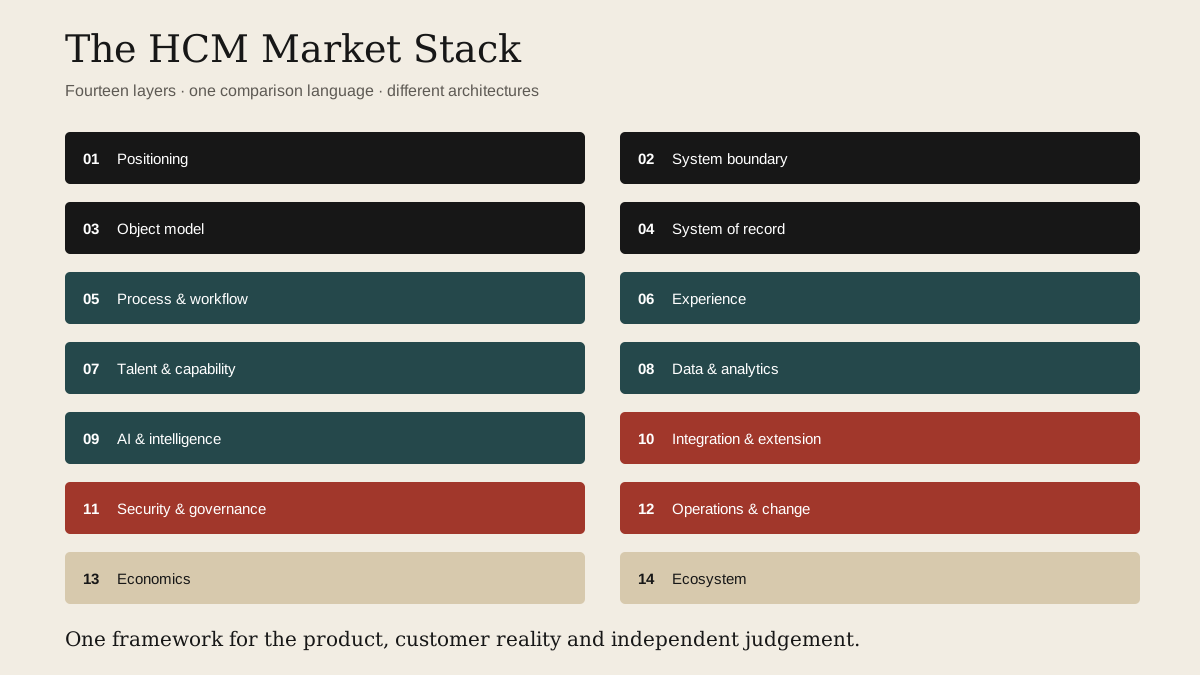
Each dossier follows the same fourteen-layer structure so that products can be compared without flattening their architectural differences. It examines the product and its technical foundations, then tests the proposition against customer experience, implementation reality, competitive position and likely direction.
Employee Central, talent, payroll, People Intelligence, BTP, Joule and the architectural reasons apparently simple changes can be difficult.
Read or listen →Object model, business processes, security, analytics, Skills Cloud, Sana and Flex Credits.
Read or listen →Fusion HCM, Redwood, Dynamic Skills, analytics, OCI agents and integration.
Read or listen →| Layer | What must be understood |
|---|---|
| 1 · Positioning | The management problem the vendor says it solves |
| 2 · Boundary | What is native, acquired, connected or external |
| 3 · Object model | How people, jobs, positions, organisations, skills and agents are represented |
| 4 · Record | Authoritative data, effective dating and lifecycle |
| 5 · Process | Rules, workflows, events and exceptions |
| 6 · Experience | Employee, manager, candidate, HR and administrator interaction |
| 7 · Capability | Recruiting, learning, performance, succession, skills and planning |
| 8 · Data | Reporting, analytics, semantics and operational joins |
| 9 · Intelligence | Prediction, generation, recommendation and agents |
| 10 · Extension | APIs, integration, events, custom objects and low-code |
| 11 · Governance | Identity, permission, privacy, audit and agent authority |
| 12 · Operations | Release, testing, migration, support and ownership |
| 13 · Economics | Licence, consumption, implementation and hidden cost |
| 14 · Ecosystem | Partners, marketplaces, dependencies and lock-in |
The fourteen layers explain how a platform is constructed and operated. The lifecycle overlay tests what that platform enables across work and employment. These stages are not separate software silos: each one crosses the object model, workflow, experience, data, intelligence, integration and governance layers.
| Lifecycle stage | What the analysis tests |
|---|---|
| 1 · Plan and organise | Workforce structures, positions, capacity, cost and scenario planning |
| 2 · Attract and recruit | Demand, sourcing, candidates, assessment, selection and offers |
| 3 · Hire and onboard | Identity conversion, pre-boarding, documents, provisioning and readiness |
| 4 · Schedule, time and absence | Availability, shifts, attendance, leave, exceptions and compliance |
| 5 · Pay and reward | Compensation, benefits, payroll, recognition and workforce cost |
| 6 · Develop and mobilise | Skills, learning, careers, internal opportunity and deployment |
| 7 · Perform and progress | Goals, contribution, feedback, succession and advancement |
| 8 · Engage and support | Employee listening, communications, service, wellbeing and daily experience |
| 9 · Retain and redeploy | Risk, mobility, workforce reshaping and capability continuity |
| 10 · Exit and maintain obligations | Termination, access removal, final pay, records, alumni and continuing duties |
The resulting view is a matrix: lifecycle stages show where value is delivered; the fourteen layers reveal how that value is produced and what it depends on.
| Label | Meaning |
|---|---|
| Generally available | A customer can buy and deploy it, subject to edition and geography |
| Limited / preview | Restricted access, incomplete coverage or non-production status |
| Announced | Vendor direction rather than a purchasing assumption |
| Partner-dependent | Requires another product, implementer or customer-built layer |
| AyEye inference | An analytical conclusion, explicitly separated from vendor fact |
Each dossier carries an evidence date and version. Six-month reviews check general availability, roadmap delivery, packaging, pricing logic, acquisitions, retirements, architectural change, customer evidence and the competitive judgement. Material changes create a visible update note. Previous conclusions are corrected openly rather than disappearing.
Baseline: version 1.1, 23 September 2026. Next planned review: March 2027.
Version 1.1 · 23 September 2026: added the workforce-lifecycle overlay to distinguish functional coverage from the architectural and operating layers.