
Workday HCM: can one coherent core become the interface for all work?
A deep guide to Workday’s object model, Business Process Framework, security, analytics, Skills Cloud, Sana, Flex Credits and the limits of architectural coherence.
WORKDAY · PRODUCT, ARCHITECTURE AND DIRECTION
Workday’s enduring proposition is architectural coherence: people, money, planning and increasingly agents operate through a shared object, security and business-process platform. That claim has more substance than most suite narratives. The critical question in 2026 is whether Sana, the Agent System of Record and a growing set of acquired products extend that coherence—or turn Workday into the integrated portfolio it once contrasted itself against.
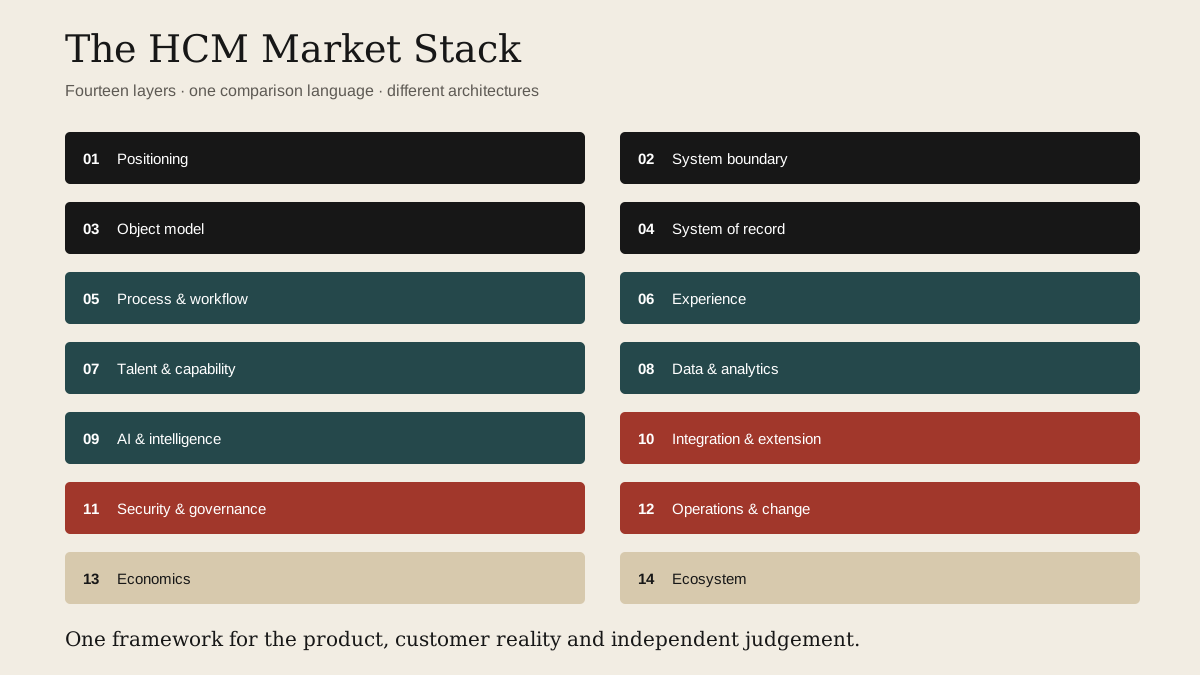
The fourteen-layer market test
| Layer | What must be understood |
|---|---|
| 1 · Positioning | The management problem the vendor says it solves |
| 2 · Boundary | What is native, acquired, connected or external |
| 3 · Object model | How people, jobs, positions, organisations, skills and agents are represented |
| 4 · Record | Authoritative data, effective dating and lifecycle |
| 5 · Process | Rules, workflows, events and exceptions |
| 6 · Experience | Employee, manager, candidate, HR and administrator interaction |
| 7 · Capability | Recruiting, learning, performance, succession, skills and planning |
| 8 · Data | Reporting, analytics, semantics and operational joins |
| 9 · Intelligence | Prediction, generation, recommendation and agents |
| 10 · Extension | APIs, integration, events, custom objects and low-code |
| 11 · Governance | Identity, permission, privacy, audit and agent authority |
| 12 · Operations | Release, testing, migration, support and ownership |
| 13 · Economics | Licence, consumption, implementation and hidden cost |
| 14 · Ecosystem | Partners, marketplaces, dependencies and lock-in |
Workforce lifecycle coverage
This map locates the principal Workday capabilities and the dependency most likely to shape real-world delivery. It is a coverage guide, not a completeness score.
| Stage | Principal product centre | Important dependency or seam |
|---|---|---|
| Plan and organise | Core HCM organisations and staffing models with Adaptive Planning | Transactional structures and planning dimensions need deliberate semantic alignment |
| Attract and recruit | Workday Recruiting and connected talent-acquisition services | Job boards, assessments and acquired capabilities introduce external data and workflow seams |
| Hire and onboard | Recruiting, onboarding journeys, Core HCM and the Business Process Framework | Pre-hire identity, worker conversion, security activation and provisioning must remain coordinated |
| Schedule, time and absence | Time Tracking, Absence and scheduling capabilities | Frontline complexity, local agreements, clocks and payroll geography affect fit |
| Pay and reward | Compensation, Benefits and Workday Payroll | Payroll availability varies by country and may require local or partner solutions |
| Develop and mobilise | Learning, Talent Marketplace and Skills Cloud | Skills inference and marketplace matching require evidence, governance and adoption |
| Perform and progress | Performance, Talent, Succession and the Business Process Framework | Object, process and security configuration jointly determine the experience |
| Engage and support | Employee experience, Peakon Employee Voice and Sana | Acquired data models, consent and action ownership must be connected to the core |
| Retain and redeploy | Skills Cloud, Talent Marketplace, People Analytics and Adaptive Planning | Matching and risk signals should not be mistaken for verified capability or intent |
| Exit and maintain obligations | Termination business processes, Payroll, Benefits and integrations | Final pay, access removal, records and downstream systems require coordinated events |
Executive judgement
AYEYE VERDICT · CONFIDENCE: MEDIUM-HIGH
Workday’s native transaction and security model remains its clearest advantage. Its next risk is confusing a coherent core with a complete enterprise intelligence layer.
1–4 · The Workday model
Workday represents the enterprise through business objects and relationships rather than conventional application modules sitting over separate databases. Worker, position, job profile, supervisory organisation, company, cost centre and event are connected objects. Reports navigate those relationships, calculated fields derive meaning and the security model controls access at domain and business-process level. This enables real-time reporting on transactional data without waiting for a separate reporting warehouse for many operational questions.
Workers can be employees or contingent workers; staffing models can be position management or job management; supervisory organisations provide a central management hierarchy while companies, cost centres, regions and custom organisations create other views. Effective-dated events preserve history and future change. The elegance is real, but so is the learning curve: configuration choices made early about organisations, staffing and security shape almost every later process.
5 · The Business Process Framework
Transactions such as hire, change job, compensation review and termination run through configurable business processes with initiation rules, approvals, reviews, to-dos, integrations and notifications. Conditions can vary routes according to worker, organisation, event and calculated fields. This gives functional teams considerable power without custom code. It also means a request that sounds like a screen change can affect security, routing, reporting and integrations attached to the event.
Workday’s framework is strongest when customers accept its event model and govern calculated fields, condition rules and security carefully. Excessive local variation creates a thicket that remains “configuration” but behaves like custom software.
6–7 · Experience and capability
The traditional Workday experience has been consistent but not always loved: users appreciate a single environment while criticising navigation, terminology and the number of steps needed for occasional tasks. Workday has responded with role-based experiences, mobile improvements and now Sana as a conversational front door. In March 2026 Workday made Sana for Workday and its Self-Service Agent available through Flex Credits, describing more than 300 skills across HR and finance.
Skills Cloud uses machine learning to infer, normalise and relate skills across workers, jobs and opportunities. Its advantage is proximity to Workday transactions and talent processes. Its limitation is common to all skills systems: inference is not evidence of mastery, and a shared ontology does not by itself create trusted proficiency or opportunity. Workday Recruiting, Learning, Talent, Peakon Employee Voice, VNDLY, Adaptive Planning and the newer Paradox and Sana assets broaden the proposition, but not every acquired product shares the native object model to the same degree.
8–9 · Data, Illuminate and Sana
Operational reporting, discovery boards, dashboards and Worksheets sit close to Workday data. Prism Analytics brings external data into governed analysis; Adaptive Planning supports workforce and financial scenarios; the Data Cloud proposition aims to reduce pipelines between Workday and external platforms. Customers still use enterprise lakes and warehouses when they need broad operational history, data science or a vendor-neutral semantic layer.
Workday Illuminate is the AI umbrella; Sana becomes the interaction and orchestration layer. Workday claims Sana can find, act, build and automate across Workday and connected systems. The Self-Service Agent inherits Workday security and audit context, while Sana Enterprise adds connectors to Microsoft, Google, Salesforce, ServiceNow, Slack and other systems. This is strategically significant: Workday is moving from application UX towards an enterprise work interface.
The hard questions concern action boundaries, grounding, connector depth, consumption and agent governance. A connector that searches SharePoint is not equivalent to a transaction that updates a governed record. A self-service skill is not the same thing as an autonomous process. Flex Credits make consumption legible but also turn agent use into a variable portfolio cost.
10–12 · Integration, extension and operations
Integration options include delivered connectors, Enterprise Interface Builder, Workday Studio, REST and SOAP web services, reports-as-a-service and Workday Orchestrate. Workday Extend allows applications to use Workday data, security and UI patterns. The strength is governed extension close to the core. The trade-off is platform dependence and specialist skills.
Workday security is powerful because access follows domains, business processes, organisations and roles. It is also one of the most specialised areas of the platform. Segregation of duties, constrained roles, integration-system users and inherited access require disciplined design. Agent identities make this more important: every action should resolve to a bounded agent mandate and accountable human or process owner.
Twice-yearly feature releases and weekly service updates require preview review, regression testing and change communication. Customers receive preview tenants, but effective testing depends on representative data, integrations and ownership. The “always on one version” model removes technical upgrades while retaining organisational upgrade work.
13–14 · Economics and ecosystem
Workday pricing is quote based and commonly shaped by worker population, product subscriptions, contract term, services, integrations, Extend, analytics and planning. In 2026 Sana consumption is channelled through Flex Credits; an allocation comes with subscriptions, while broader use can increase consumption cost. Buyers should model steady-state consumption, not only pilot activity.
The ecosystem is mature, with large consultancies, boutique specialists and Marketplace solutions. Workday’s configuration model can reduce conventional custom code but increase reliance on certified specialists. Total cost is driven by tenant design, data conversion, integrations, testing, security and the internal product team required after go-live.
CUSTOMER EXPERIENCE AND DELIVERY REALITY
What customers tend to value and struggle with
Customers commonly value a consistent platform, strong auditability, embedded reporting, configurable processes and the ability to update organisational structures without traditional ERP development. Common friction includes report and calculated-field complexity, security diagnosis, integration maintenance, constrained local variation, recruiting and candidate experience, and the gap between a clean global design and country exceptions.
Mature stacks often add service delivery, specialist payroll, learning experience, workforce analytics or data platforms. The existence of an acquired or partner product does not invalidate Workday’s core; it shows where “one system” becomes an ecosystem.
INDEPENDENT ASSESSMENT
Structural strengths
- One business-process and security framework across the native core.
- Real-time transactional reporting and traceable effective-dated events.
- A strong link among HCM, finance and planning.
- Extend and Orchestrate provide governed routes beyond configuration.
- Sana can turn Workday context into a credible agentic interface if actions remain transparent.
Structural limits
- The native model can become the boundary of what is easy to represent.
- Acquisitions complicate the “single architecture” story.
- External operational context still requires data and integration architecture.
- Skills inference and agent recommendations can appear more certain than their evidence.
- Flex Credits require active value and consumption governance.
Questions for Workday
- Is this capability native to the object model or integrated from an acquired product?
- Which business object, security domain and process event govern it?
- What can Sana read, recommend and execute separately?
- How are agent actions attributed, challenged and reversed?
- What consumes Flex Credits and how can use be forecast?
- Which data remains difficult to export or combine outside Workday?
- Which changes require Extend or Orchestrate rather than configuration?
ONE THING
IF I WERE TO DO ONE THING NOW
Test one supposedly simple change against the object–process–security triangle
Take a requested experience improvement and identify the business object being changed, the process event through which it changes and the security domains that expose it. Then add every report, integration and agent skill that consumes the result. This reveals whether the change is local configuration or a platform-level design decision.
Sources and status
Sana from Workday, March 2026 · Workday core technology. Product-performance statements remain vendor claims unless supported by independent evidence.
Version 1.1 update. Added the workforce-lifecycle overlay so functional coverage can be read separately from the fourteen architectural and operating layers.
Maintenance note. This is a dated analytical baseline, not a permanently current product sheet. Material changes are recorded in the series change log. Generally available capability, preview, announced direction, partner dependency and AyEye inference are kept separate.