
SAP SuccessFactors: an HCM suite becoming an enterprise intelligence layer?
A technical, commercial and critical guide to Employee Central, talent, payroll, data, BTP, Joule and the practical constraints behind SAP’s connected HCM proposition.
SAP · PRODUCT, ARCHITECTURE AND DIRECTION
SAP SuccessFactors is often spoken about as though it were one application with a collection of screens. It is better understood as a cloud HCM portfolio whose centre of gravity is Employee Central, connected to talent products, payroll, analytics, SAP Business Technology Platform and an expanding layer of Joule assistants and agents. Its greatest potential advantage is not simply HR functionality. It is proximity to the operational and financial context of the wider SAP estate. Its recurring difficulty is that proximity does not automatically make the portfolio one coherent system.
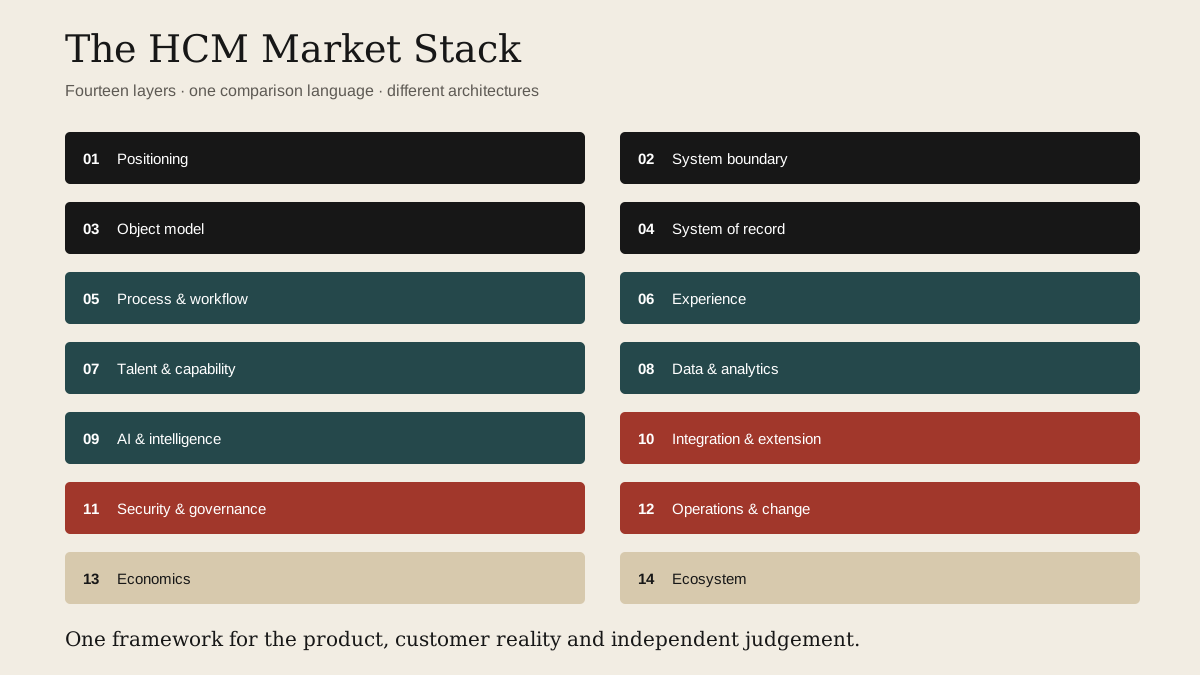
The fourteen-layer market test
| Layer | What must be understood |
|---|---|
| 1 · Positioning | The management problem the vendor says it solves |
| 2 · Boundary | What is native, acquired, connected or external |
| 3 · Object model | How people, jobs, positions, organisations, skills and agents are represented |
| 4 · Record | Authoritative data, effective dating and lifecycle |
| 5 · Process | Rules, workflows, events and exceptions |
| 6 · Experience | Employee, manager, candidate, HR and administrator interaction |
| 7 · Capability | Recruiting, learning, performance, succession, skills and planning |
| 8 · Data | Reporting, analytics, semantics and operational joins |
| 9 · Intelligence | Prediction, generation, recommendation and agents |
| 10 · Extension | APIs, integration, events, custom objects and low-code |
| 11 · Governance | Identity, permission, privacy, audit and agent authority |
| 12 · Operations | Release, testing, migration, support and ownership |
| 13 · Economics | Licence, consumption, implementation and hidden cost |
| 14 · Ecosystem | Partners, marketplaces, dependencies and lock-in |
Workforce lifecycle coverage
This map locates the principal SAP capabilities and the dependency most likely to shape real-world delivery. It is a coverage guide, not a completeness score.
| Stage | Principal product centre | Important dependency or seam |
|---|---|---|
| Plan and organise | Employee Central structures, position management and workforce analytics/planning | Finance and operational planning may sit across SAP Analytics Cloud, Business Data Cloud and other planning systems |
| Attract and recruit | SuccessFactors Recruiting and the developing SmartRecruiters proposition | Coexistence, integration and migration choices must be explicit |
| Hire and onboard | Recruiting, Onboarding and Employee Central | Candidate, person, employment and user identities have distinct security and lifecycle rules |
| Schedule, time and absence | Employee Central Time Management and Time Tracking | Complex scheduling, clocks, local rules and payroll interfaces can extend beyond the core |
| Pay and reward | Compensation, Variable Pay, Benefits and Employee Central Payroll | Payroll uses a separate replicated landscape; country coverage and cut-off controls matter |
| Develop and mobilise | Learning, Career and Talent Development, Opportunity Marketplace and Talent Intelligence Hub | Skills value depends on taxonomy, proficiency evidence and consistent adoption |
| Perform and progress | Performance and Goals, Calibration and Succession | Module-specific permissions, templates and process histories can create seams |
| Engage and support | Home and mobile experiences, Joule and employee-service capabilities | A coherent experience can depend on BTP, service tooling and connected content |
| Retain and redeploy | Succession, Opportunity Marketplace and People Intelligence | Recommendations should distinguish inferred potential from evidenced readiness |
| Exit and maintain obligations | Employee Central termination processes, payroll and document/integration services | Identity removal, final pay, retention and downstream de-provisioning cross several systems |
Executive judgement
AYEYE VERDICT · CONFIDENCE: MEDIUM-HIGH
SuccessFactors has the richest route from HCM into enterprise context, but customers must actively engineer the connections that SAP’s positioning can make sound native.
For SAP-centred organisations, the platform can connect workforce decisions to finance, process and operations more credibly than a standalone HCM suite. Yet Employee Central, talent applications, Employee Central Payroll, SmartRecruiters, People Analytics, Business Data Cloud, BTP and Joule do not collapse into one data model merely because they share a logo.
1–4 · Positioning, boundary and the model underneath
GENERALLY AVAILABLE. Employee Central is the core HR system of record. The important technical distinction is that a person, an employment, a user and a person’s job information are related but not identical records. A person can have more than one employment; employments can change status; job and compensation records are effective dated; the user record exists partly to support application access. This is why an external candidate cannot simply be treated as an internal employee by changing a label. Candidate consent, identity, security, retention and lifecycle are genuinely different.
Employee Central combines delivered HR entities with foundation objects such as legal entity, business unit, department, division, location, job classification, pay structures and cost centres. Many are effective dated and country-sensitive. The Metadata Framework, usually called MDF, supports configurable generic objects, associations, rules and UI definitions. MDF is powerful, but a custom object does not become a first-class native object in every downstream module merely because it exists.
CONSTRAINT. SuccessFactors grew through both internal development and acquisition. Talent modules have become progressively more integrated, but they retain seams in data, permission, workflow and user experience. Employee Central Payroll is not a payroll calculation engine rebuilt on the Employee Central object model; it is a cloud-delivered descendant of SAP’s mature ERP HCM payroll engine, supplied through a separate landscape and fed through controlled replication. That separation provides depth and localisation, but it makes master-data correctness, replication monitoring and cut-off discipline fundamental.
5 · Process: rules are not one thing
Change in SuccessFactors can be deceptively easy to describe and slow to implement because behaviour can be distributed across data models, business rules, event reasons, workflows, role-based permissions, picklists, country configuration, integrations and module-specific logic. A recruiter may reasonably ask why internal and external candidates cannot follow the same route. The answer may involve separate identities, employee data that an external applicant must not see, internal mobility rules, duplicate prevention, consent, onboarding conversion and reporting lineage.
Business Rules can default, validate, calculate, trigger workflows and control behaviour at defined events. Workflow routing can depend on dynamic roles and organisational relationships. Intelligent Services publishes business events for downstream activity, while Integration Center can build scheduled or event-triggered integrations. The design question is not merely “can we configure this?” but “which layer should own the rule, and which consumers will assume the old behaviour?”
6–7 · Experience, talent and skills
SAP has improved suite navigation, mobile access and role-based home experiences, but customer reality remains mixed because users cross old and new interfaces and because different modules expose different configuration philosophies. The 2026 proposition adds native integration among SmartRecruiters, Employee Central and Onboarding. SAP acquired SmartRecruiters in 2025 and states that existing SuccessFactors Recruiting customers are not required to migrate. That is commercially reassuring but architecturally revealing: the future recruiting experience is a connected acquired product, not simply a new screen over the old recruiting engine.
The Talent Intelligence Hub is intended to provide a shared skills foundation across talent processes. Its value depends less on the existence of an AI-generated skills catalogue than on governance: synonym control, proficiency meaning, evidence, ownership, decay and consistent use in recruiting, learning, performance and planning. SAP’s 1H 2026 release adds stronger skills-governance capabilities. Treat that as an enabling foundation, not proof that skills-based workforce decisions are already reliable.
8–9 · Analytics, People Intelligence and Joule
SuccessFactors reporting has several historical layers: operational reports, Story reports using embedded SAP Analytics Cloud technology, Workforce Analytics and external enterprise analytics. People Intelligence in SAP Business Data Cloud represents a strategic move: curated data products, SAP and non-SAP data, analytics and AI services can sit above the transactional suite. This could become SAP’s real workforce-intelligence layer because it can connect HR with finance and operations. It also creates another product and commercial boundary to govern.
GENERALLY AVAILABLE AND EXPANDING. Joule provides conversational assistance grounded in SAP context. SAP’s 1H 2026 material describes agents across recruiting, workforce administration, payroll, learning, performance and development, plus an Employee Data Integration Agent and intelligent learning Q&A. The right technical questions are: which agent is generally available in the customer’s edition and geography; which business objects and APIs it can read or change; whether it recommends, drafts or executes; what approval is required; where action and evidence are logged; and what consumption is included.
Joule can participate in non-SAP actions when tools, APIs and permissions are exposed through BTP and agent orchestration, but that is different from unrestricted control of external applications. SAP’s strongest AI story is grounded business context. Its weakest possible implementation is a conversational layer that inherits fragmented semantics underneath.
10–12 · Integration, security and operating change
The integration toolbox includes OData APIs, the CompoundEmployee API, Integration Center, scheduled file exchange, Intelligent Services events, SAP Integration Suite and partner middleware. OData is the normal object-oriented interface; CompoundEmployee remains important for extracting complex employee lifecycle data. API availability, effective-dated behaviour, pagination, delta logic and permission context vary by entity. “There is an API” is therefore the beginning of design, not the conclusion.
Role-Based Permissions combine target populations with permission roles and groups. They can express sophisticated access, but complexity rises quickly when global, local, HR, manager and proxy scenarios overlap. Identity provisioning, inactive users, concurrent employment and contingent-worker access deserve deliberate design. AI agents should receive their own traceable authority envelope rather than borrowing a broadly privileged service user.
SAP uses two major SuccessFactors releases each year, with continuous smaller changes around them. Customers need release triage, regression testing, integration monitoring, role testing and ownership of optional versus automatically enabled features. Configuration transport and environment refresh are not equivalent to software deployment in a conventional application stack; data, configuration and security dependencies need their own controls.
13–14 · Economics and ecosystem
SAP now markets HCM Base and Premium packages, with price on request, contracts typically running one to five years and Joule Base included. Base includes core people data, self-service, localisation, compensation and performance; Premium adds learning, career and talent capabilities and predictive insight. Actual economics still depend on employee counts, modules, payroll countries, analytics, BTP, integration volume, implementation partner, environments, support tier and AI consumption beyond included capability.
The partner ecosystem is a strength and a cost. It provides localisation and specialist implementation capacity, but creates variation in design quality and ongoing dependency. The cheapest licence proposal can produce the most expensive operating model when configuration, integration and regression knowledge remain outside the organisation.
CUSTOMER EXPERIENCE AND DELIVERY REALITY
What mature customer stacks usually contain
- Employee Central as core HR, with finance and identity integrations.
- Separate payroll engines or providers, even where Employee Central Payroll is used in some countries.
- An integration platform and monitoring discipline outside the HCM team.
- Additional recruiting, learning experience, listening, case management or workforce-planning products where local needs exceed suite capability.
- A data warehouse or lakehouse for cross-enterprise analytics.
- Specialist release, security and data-governance roles that are invisible in the product brochure.
Typical positive experience centres on global localisation, breadth, compliance learning, integration with SAP business processes and the ability to standardise. Typical frustration centres on inconsistent user journeys, reporting complexity, permission troubleshooting, integration dependencies and slow change where a request crosses lifecycle boundaries. Neither picture is universal. Implementation design and data maturity explain a large part of the variation.
INDEPENDENT ASSESSMENT
Where SAP is structurally strong
- Enterprise context: finance, cost, process, supply chain and workforce data can be connected within one strategic ecosystem.
- Global depth: localisation, payroll heritage and regulated learning support large complex employers.
- Extension: BTP provides a governed route for applications, integration, data and agents beyond HCM.
- Process intelligence: Signavio, LeanIX, WalkMe and Cloud ALM can connect work design, architecture, adoption and operation—if customers actually integrate the governance.
Where the proposition can outrun the architecture
- “One suite” can conceal synchronisation between different products and objects.
- AI agents cannot repair uncertain master data, ownership or decision rights.
- Skills intelligence can generate attractive profiles without dependable evidence of competence.
- Business Data Cloud can become another layer of cost and stewardship rather than an automatic single truth.
- SmartRecruiters improves the future recruiting story while creating a transition decision for existing Recruiting customers.
Questions worth asking in a technical change discussion
- Which exact object is authoritative, and is it effective dated?
- Is this behaviour controlled by data model, rule, workflow, permission, integration or module code?
- Which internal, external and contingent identities are involved?
- What downstream consumers rely on the current event or field?
- Is the requested AI capability available, previewed or merely on the roadmap?
- What can the agent change, under whose authority and with what audit record?
- Does the solution require BTP, Business Data Cloud, Integration Suite or another licence?
- How will the change be regression tested across countries and modules?
ONE THING
IF I WERE TO DO ONE THING NOW
Draw the identity-to-outcome chain for one frustrating HR journey
Take one complaint—such as treating internal and external candidates consistently—and trace person, candidate, employment, user, position, job requisition, permission, workflow, integration and reporting objects from start to finish. Mark which system owns each object and which policy requires the distinction. Only then decide whether the answer is configuration, integration, process redesign or a product limitation. That exercise turns “SAP is slow” into an actionable architecture discussion.
Sources and status
SAP SuccessFactors 1H 2026 release · SmartRecruiters integration · MDF OData documentation · Employee Central Payroll integration · SAP HCM packaging.
Version 1.1 update. Added the workforce-lifecycle overlay so functional coverage can be read separately from the fourteen architectural and operating layers.
Maintenance note. This is a dated analytical baseline, not a permanently current product sheet. Material changes are recorded in the series change log. Generally available capability, preview, announced direction, partner dependency and AyEye inference are kept separate.