
Workforce Management: A Sheep in Wolf’s Clothing?
Is Workforce Management the successor to Human Capital Management—or merely old administration in an AI costume? Agentic AI creates the possibility of a new intelligence function connecting work, people, agents and outcomes. It will take more than a name change.

WORKFORCE MANAGEMENT · LONG READ · ORIGINAL SYNTHESIS
There is something faintly suspicious about a sheep in a wolf’s coat. From across the field it looks newly formidable. Up close, it is still chewing the same grass.
That may be the risk in the emerging language of workforce management. As agentic AI enters organisations, Human Capital Management appears ready for another grand change of name. The new label sounds operational, intelligent and closer to the business. Yet “workforce management” has traditionally meant a narrower set of activities: scheduling, time, attendance, capacity and labour cost. If all we do is automate those controls, we have not invented the successor to HCM. We have put sharper teeth on administration.
The more consequential possibility is different. AI could absorb much of the administrative machinery while a new enterprise intelligence function forms above it—one that continuously connects strategy, work, human capability, machine capability, cost, risk and outcomes. That would be comparable in importance to the historical move from personnel administration towards strategic HR. It would also challenge HR’s borders far more deeply than that earlier transition did.
THE PROPOSITION
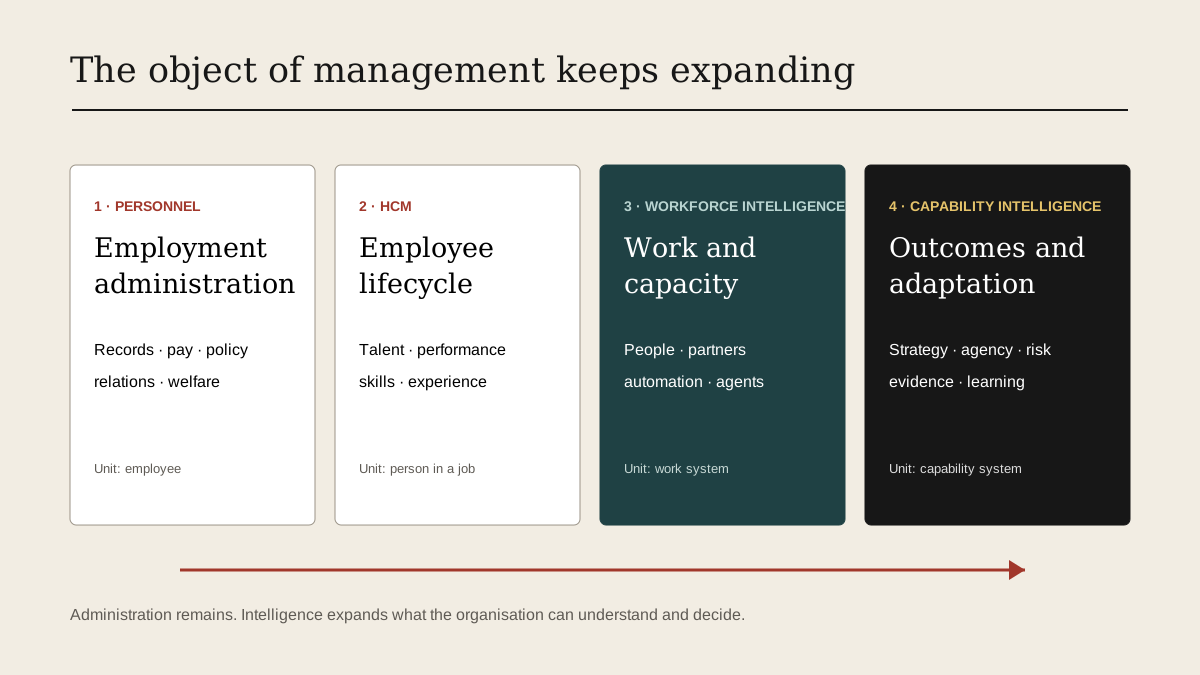
Personnel managed employment. HCM managed the employee lifecycle. Workforce intelligence must manage the evolving relationship between work, human capability and machine capability.
We have changed the name before
The history of the profession is not a neat march from clerks to strategists. It is a series of expansions in what organisations believed had to be understood and governed.
The UK profession began in 1913 with welfare work. During the 1920s, labour officers dealt with recruitment, discipline, dismissal and industrial relations. The Institute of Labour Management became the Institute of Personnel Management in 1946 as industrial relations and training grew in importance. Personnel and development were formally combined in 1994; the CIPD arrived in 2000. The chronology matters because every renaming followed a real broadening of the problem, even though older administrative work remained underneath. CIPD history
Human Resource Management then promised something more strategic: people as a source of organisational capability rather than a cost category to administer. Human Capital Management made the idea more measurable and systematised it through workforce plans, talent cycles, competency frameworks, performance records and integrated platforms.
That architecture achieved a great deal. It also inherited a stubborn unit of analysis: the employee in a job. Systems were built around people, positions, reporting lines, events and transactions. Work appeared indirectly through job descriptions, goals, time records and process steps. Capability appeared through skills profiles and course completions. The organisation could know a remarkable amount about an employee while remaining surprisingly vague about whether the work could be performed.
Agentic AI breaks that comfortable equivalence. A job is no longer the smallest useful container for work. Tasks can move between employees, contractors, services, conventional automation and AI agents. Decisions can be recommended by one system, made by another and authorised by a person. Capacity can be purchased by licence, token or outcome rather than headcount. The object that must be understood is no longer simply the workforce. It is the work system.
The administrative core will not disappear
There is a fashionable version of this argument in which AI handles the dull work and HR finally becomes strategic. HR has been promised this liberation by shared services, outsourcing, self-service portals, ERP, SaaS and robotic process automation. Administration usually becomes more efficient; it rarely vanishes. Regulation changes, data degrades, exceptions multiply and employees still need somebody to resolve the thing that the workflow insists cannot have happened.
Agentic systems may nevertheless alter the economics. An agent can gather information, check completeness, explain a policy, initiate a transaction, chase an approval, reconcile inconsistencies and escalate an exception. Unlike a conventional workflow, it can interpret context and select among actions. That can compress the distance between a question and a completed service.
But an agent does not remove the need for a system of record, valid master data, access control, decision rights or accountable process ownership. It is more likely to expose their weaknesses. A beautifully conversational interface placed above contradictory job data and six definitions of “active employee” merely allows the organisation to become confused more fluently.
This is why “data first” is not a technical slogan. Intelligence depends on stable identities, meaningful relationships, provenance and permissions. Before an agent can recommend redeployment, the organisation must know which person, role, skill, task, location, obligation and outcome it is talking about. Before it can act, it needs an explicit mandate.
The sheep’s coat test
If the proposed transformation leaves the underlying objects, decisions, accountabilities and measures unchanged, it is a costume. Faster transactions are valuable, but they are not a new management function.
The evidence says the unit of work is already changing
No single statistic proves the birth of workforce intelligence. Several signals, read together, show why the old model is under strain.
- AI exposure is broad, but job extinction is not the dominant near-term mechanism. The International Labour Organization estimates that one in four workers globally is in an occupation with some generative-AI exposure. Because human input remains necessary, it expects transformation to be more common than redundancy. ILO, 2025 update
- Skills are moving faster than job architecture. PwC’s analysis of almost a billion job advertisements found that employer skill requirements were changing 66% faster in the most AI-exposed occupations than in the least exposed. It also reported a 56% average wage premium for workers with AI skills. These are associations rather than proof that AI caused the outcomes, but they show why static annual skills reviews are becoming inadequate. PwC Global AI Jobs Barometer, 2025
- Leaders expect agents to enter the operating model. Microsoft’s 2025 Work Trend Index surveyed 31,000 workers across 31 countries. Eighty-one per cent of leaders expected agents to be integrated moderately or extensively into AI strategy within 12–18 months; 45% ranked expanding capacity with digital labour as a near-term priority. The study is vendor research and its “Frontier Firm” framing promotes Microsoft’s strategic direction, but the management expectation is still revealing. Microsoft Work Trend Index, 2025
- Management is already partly computational. A recent OECD employer survey of more than 6,000 mid-level managers found at least one algorithmic-management tool in 90% of surveyed US firms, 79% on average across France, Germany, Italy and Spain and 40% in Japan. Sixty per cent of users thought the tools improved decision quality, while nearly two-thirds reported at least one trustworthiness concern. Unclear accountability was the most common specific problem. OECD, 2026
Together these findings suggest neither a simple automation story nor a clean replacement of employees by agents. Work is being decomposed, skills are changing, managerial decisions are becoming software-mediated and machine capacity is entering teams. The resulting problem is one of continuous configuration.
HCM is necessary, but it is no longer the whole map
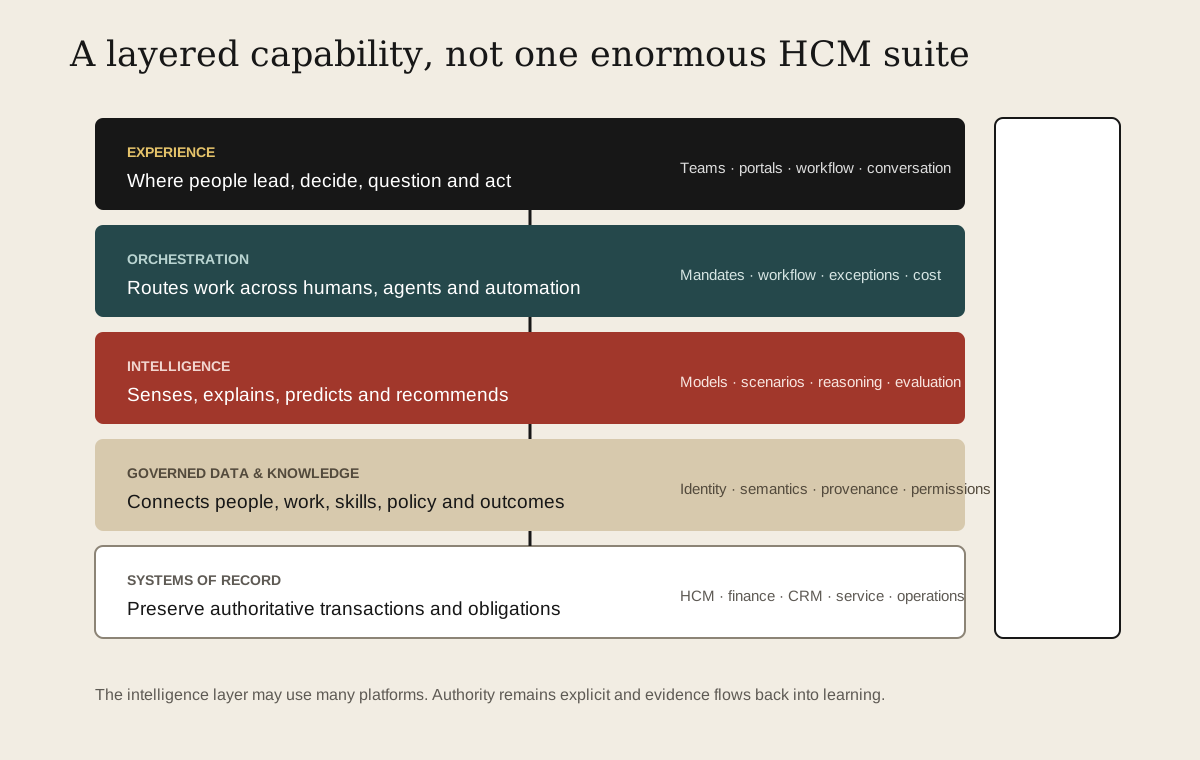
A modern HCM platform remains essential. It should hold authoritative records for employment, organisation, reward, time, learning, performance and other regulated processes. The mistake would be asking it to become the sole intelligence and orchestration layer for every form of work.
That creates three constraints. First, HCM data is centred on employment structures and periodic events, while operational work is spread across service, finance, sales, engineering, project and knowledge systems. Second, a single vendor’s semantic model can become the boundary of what the organisation is able to ask. Third, agents will need to act across multiple environments; placing all intelligence inside one suite turns integration convenience into long-term dependency.
A layered model is more resilient. Systems of record preserve authoritative transactions. A governed data and knowledge layer connects people, work, skills, policy, finance and operational evidence. An intelligence layer reasons over that context. An orchestration layer coordinates agents, workflows and human decisions. Experience channels bring the capability into the places where work happens. Governance spans the stack rather than being added at the end.
What would the intelligence function actually do?
The function’s purpose would not be to produce more dashboards. It would help leaders make better decisions about how outcomes are achieved. Its recurring questions would include:
- What work must be done, changed or stopped to deliver the strategy?
- Which combination of employees, partners, automation and agents should perform it?
- Where is capability constrained: skill, knowledge, process, data, technology, authority or capacity?
- Which decisions may be delegated, and under what limits?
- What human work is created around apparently autonomous systems?
- Which interventions improve the outcome, rather than merely increasing activity?
- How should value, cost, risk and the human consequences be measured together?
This work cuts across HR, Finance, IT, Operations, Data, Risk and Strategy. That is not an argument for an imperial HR land-grab. It is an argument for a shared design object: organisational capability.
HR brings knowledge of people, organisation, employment, skills, culture and human consequences. IT brings architecture, platforms, identity, security and technical operations. Finance brings value, cost and planning discipline. Operations brings the reality of work. Risk and Legal define acceptable consequence. No single function possesses the whole answer; each can optimise its part while the capability still fails.
The new function might therefore be called Workforce Intelligence, but even that name may prove too human-centred. Organisational Intelligence describes the sensing and decision role. Capability Management describes the object. The final label matters less than whether the organisation creates the authority and mechanisms to connect these disciplines.
Five hypotheses worth testing
- The next strategic HR function will own fewer processes and influence more decisions. Its value will come from the quality of its models, evidence and interventions rather than the number of transactions under its control.
- Skills intelligence without work intelligence will disappoint. Knowing that an employee has a skill is useful only when it connects to a task, decision, outcome and opportunity to apply it.
- Agent capacity will make human constraints more visible. As execution becomes cheaper, bottlenecks will migrate towards judgement, trust, permission, integration, exception handling and organisational attention.
- The HR–IT boundary will become a design interface. The argument will no longer be who owns the platform, but how human and machine agency are allocated within a governed operating model.
- Workforce planning will become capability portfolio management. Headcount and roles will remain important, but leaders will also plan token spend, agent portfolios, partner capacity, knowledge dependencies and the human labour required to supervise them.
These are propositions, not settled findings. They weaken if agents remain narrow tools, if enterprise data cannot be made coherent or if the cost of orchestration consistently exceeds the benefit. They strengthen when organisations can show that cross-functional capability decisions outperform isolated HR or technology investments.
The wolf version: what could go wrong
The same architecture that enables insight can enable surveillance. A workforce intelligence function could become an all-seeing layer that predicts attrition, scores performance, infers mood and reallocates work without meaningful voice or appeal. The OECD findings already show that instruction, monitoring and evaluation tools are widespread, while accountability and explainability remain live concerns.
The danger is not only privacy. It is epistemic overconfidence: treating partial behavioural data as a complete account of contribution. Work that is easy to count may displace work that is valuable. Correlation may harden into judgement. A recommendation may become a decision because challenging it takes longer than accepting it.
A legitimate intelligence function therefore needs constitutional limits:
- declared purposes for workforce data and derived inferences;
- minimum necessary collection rather than speculative accumulation;
- visible decision rights for humans and agents;
- worker consultation and routes to challenge consequential decisions;
- separation between evidence, inference and speculation;
- tests for disparate impact, gaming and unintended behavioural effects;
- retirement rules for models, measures and agents that no longer earn trust.
Intelligence without legitimacy becomes control. Administration with predictive analytics is still administration, only less polite.
Practical application: build the function around decisions
Do not begin with a new department, platform procurement or enterprise skills taxonomy. Begin with a consequential decision that currently crosses boundaries—for example whether to recruit, redeploy, automate or augment capacity in a customer-service process.
Map the outcome, the work required, the people and agents involved, the authoritative sources, the decision rights and the evidence of success. Identify where the current process relies on opinion, stale data or invisible labour. Then construct the smallest governed intelligence loop that improves the decision and records what happened.
| Design question | Evidence required | Likely steward |
|---|---|---|
| What outcome are we trying to improve? | Customer, operational, financial and human measures | Business owner |
| What work creates that outcome? | Tasks, decisions, exceptions and dependencies | Operations and process owner |
| What capability is genuinely constrained? | Skills, knowledge, capacity, data, technology and authority | HR, IT and operational specialists |
| Where should agency sit? | Risk, reversibility, confidence and consequence | Business, risk and architecture |
| Did the intervention work? | Before/after outcome evidence and unintended effects | Capability owner |
This creates a practical operating rhythm: sense, frame, configure, act, observe and learn. It also makes token use and agent capacity investable resources rather than novelty costs. Each use case should compete for investment on expected outcome, evidence, risk and opportunity cost—just as any other portfolio decision should.
ONE THING
IF I WERE TO DO ONE THING NOW
Choose one workforce decision and expose its full intelligence chain
Take one current decision—recruit, redeploy, train, automate or stop work—and put HR, IT, Finance and the operational owner around the same table for 90 minutes. Draw the outcome, work, data, human judgement, agent involvement, decision rights and feedback evidence on one page. Do not design the enterprise solution. Find the first break in the chain where the organisation cannot explain why it makes the decision it makes. Fixing that break will teach you more about the future function than renaming HR or buying another platform.
Questions for the executive table
- Are we managing employees, labour capacity, work or organisational capability—and where do those objects differ?
- Which decisions would improve if HR data were connected to operational, financial and technology evidence?
- Where are agents already changing jobs faster than job architecture can record?
- What human orchestration work sits around our apparently automated processes?
- Which elements must remain in authoritative systems of record, and which belong in a vendor-neutral intelligence layer?
- Who may challenge an algorithmic workforce decision, and what evidence can they inspect?
- If the function were genuinely intelligent, what would leaders decide differently next Monday?
The real test is not the title
The move from Personnel to HR mattered because the perceived organisational problem expanded. The next move will matter only if it changes the object of management again.
Calling HCM “Workforce Management” while preserving employee records, annual cycles, functional ownership and retrospective reporting would be a sheep in wolf’s clothing: a familiar administrative animal wearing the outline of strategic power.
A real transformation would embed administration, not deny it. It would establish a governed intelligence layer above systems of record. It would connect work to capability, capacity to outcomes and human agency to machine agency. It would give leaders evidence they cannot currently see and workers rights they can actually exercise. It would treat HR as an essential contributor without pretending the workforce is owned by HR.
The opportunity is not to build a more impressive people system. It is to help the enterprise understand how it performs—and continuously choose the simplest, safest and most humanly worthwhile combination of people and machines capable of improving that performance.
At that point the wolf coat can go back on its peg. The function will no longer need to look formidable. It will have become useful.
Evidence note. The historical sequence is sourced from the CIPD. ILO, OECD, Microsoft and PwC findings use different samples and methods and should not be combined as one statistical series. Microsoft and PwC are commercially interested sources; their figures are used as directional evidence and labelled accordingly. The proposed workforce-intelligence function and five hypotheses are original AyEye synthesis.